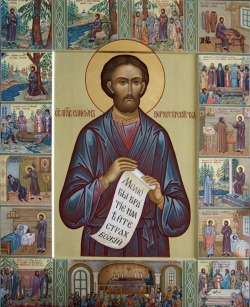
He was born in the early 17th century into a family of pious nobles. Leaving earthly wealth, he withdrew beyond the Ural Mountains, where he lived as a simple wanderer, hiding his origins. He visited the village of Merkušinskoe, where he prayed in a wooden church.
With the good news of the Trinity, he walked through the surrounding villages, turning people towards a virtuous life. In the taiga, he devoted himself to godly contemplation, seeing the wisdom of the Creator in every living being.
He did not remain idle, knowing how to sew fur coats and worked in the homes of peasants, not accepting any reward. He left his work unfinished to avoid praise and endured insults, praying for his offenders.
He prayed much for the strengthening of the faith of the newly enlightened inhabitants of Siberia, spending time in solitude on the banks of the River Tura. He caught fish, taking only as much as needed for sustenance.
He passed away in 1642 after fasting and prayer, and was buried at the Merkušin cemetery near the church of the Archangel Michael. In 1692, fifty years after his death, his incorrupt body was discovered, leading to numerous healings.
The Siberian Metropolitan Ignatius confirmed the incorruption of the relics, comparing the saint to the ancient saints. Through the prayers of Saint Simon, the Lord grants gracious help, comfort, and healing.
On September 12, 1704, by the blessing of the Metropolitan of Tobolsk Philotheus, the holy relics were transferred from the church to the Verkhoturye Monastery. The Church celebrates the second memory of the saint on December 18.
