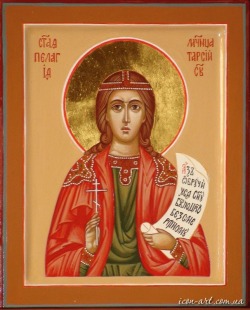
During the persecutions of Emperor Diocletian against Christians, there was a bishop named Clion in the city of Tarsus, who baptized many pagans and encouraged them to confess their faith. When Diocletian heard of the bishop’s courage, he ordered him to be arrested. However, Clion, receiving a holy revelation, left the city and hid in the mountains.
In Tarsus, there lived a noble woman named Pelagia who, after hearing about Christ, believed in Him. When the royal son proposed marriage to her, she refused, saying that she was already united to the Church of Christ. Pelagia longed to be baptized, but the bishop was not in the city.
One day, the Lord appeared to her in the likeness of Bishop Clion. Realizing that it was a vision, Pelagia secretly left her home to find him. Bishop Clion baptized her in a spring of living water, where she received the gift of the Holy Spirit.
Pelagia renounced her wealth and gave everything to the poor. When her mother learned of her faith, she was filled with rage and sought revenge on the bishop. Pelagia, realizing the danger, fled and went into hiding.
Her mother, unable to find her, accused her daughter of causing the death of the royal son, who had taken his own life. Diocletian, seeing Pelagia’s beauty, tried to turn her away from Christ by offering her wealth and power, but she remained steadfast in her faith.
The emperor ordered her to be tortured. Pelagia, making the sign of the cross, willingly threw herself into the flames and accepted a martyr’s death. Bishop Clion, upon hearing of her martyrdom, was filled with sorrow and sought her relics.
During the reign of Emperor Constantine, a church was built at the place where she was buried. The relics of Saint Pelagia rest there, while her soul gained the eternal joy of the Kingdom of God.
