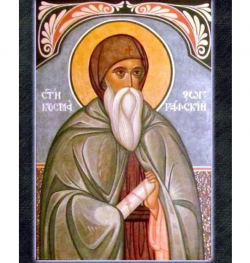
Venerable Cosmas, the Recluse of Zografou, a Bulgarian by birth, avoided marriage in his youth and secretly left his parents to go to the Holy Mountain of Athos. Even then, on his way to the Holy Land, the devil tried to shake the young man’s resolve, troubling him with a vision of an impassable sea abyss surrounding the Holy Mountain. The youth’s fervent prayer dispelled this demonic delusion.
On Athos, Saint Cosmas was received into the Zografou Monastery. There he remained a novice in obedience for a long time, then received the monastic tonsure and was appointed ecclesiarch. Saint Cosmas was granted the special grace to behold in secret the Heavenly Abbess of the Holy Mountain herself, who, on the feast of the Annunciation at the Vatopedi Monastery, was pleased visibly to reveal to him her care for her earthly portion: he saw a Woman of royal beauty and majesty, who gave orders both in the church during the service and in the refectory, while all the monks were obedient servants of hers.
Soon the saint was ordained deacon, and then presbyter, which moved him to new spiritual labors. Zealous for salvation, through his fervent prayers to the Most Holy Theotokos, the saint was again deemed worthy of a sign of her special protection: he heard the voice of the Mother of God issuing from her holy icon and asking her Son, “How shall Cosmas be saved?” The Lord’s answer was: “Let him withdraw from the monastery into silence.” Having received the abbot’s blessing, Saint Cosmas withdrew into the desert, and there, in a cave hewn into the rock, he began a new struggle of silent eremitic life. God did not abandon His faithful man of prayer: the saint was granted the gift of clairvoyance.
Just as at the beginning of his ascetic life the enemy of mankind tried to turn the saint from his chosen path, so too the final days of the righteous man became for him a grievous trial. Shortly before his death, God’s chosen one was granted a vision of Christ Himself, who informed the saint that before his soul would depart into the Kingdom of Heaven, Satan himself with his host would brutally beat and wound him. Strengthened for suffering by divine consolation, the saint courageously endured the terrible demonic torment permitted by God and, on the third day after the savage beating, having partaken of the Most Pure Mysteries, peacefully departed to the Lord with words of praise upon his lips. God, who “glorifies those who glorify Him,” wondrously glorified Venerable Cosmas after his death as well: during the saint’s burial, a multitude of beasts and birds gathered at his cave, as though understanding the common loss of the Holy Mountain; and when his body was lowered into the grave and they began to cover it with earth, each of the speechless creatures uttered a mournful cry, rendering final honor to the man pleasing to God. When, according to custom, forty days later, after an all-night vigil, the brethren opened the holy remains of the righteous one in order to transfer them with honor to the monastery, they were miraculously nowhere to be found—the Lord had concealed them. This took place in the year 1323.
