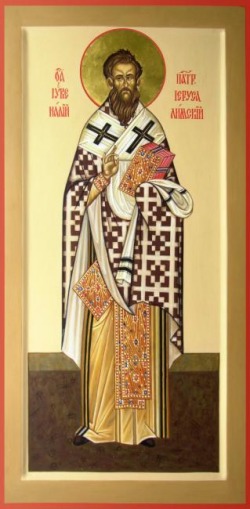
Patriarch
Saint Juvenal ascended the patriarchal throne of Jerusalem during the reign of the pious Emperor Theodosius the Younger.
During his time, the holy fathers such as Ephraim, Theodosius, and Gerasimos of the Jordan were laboring ascetically in Palestine. At that time, Nestorianism also emerged and was condemned at the Third Ecumenical Council of Ephesus, where the saint anathematized Nestorius and his teachings. After the death of Theodosius, a new heresy appeared, which was condemned at the Fourth Ecumenical Council of Chalcedon. There, Juvenal once again demonstrated his piety and wisdom.
Upon returning to Palestine, he came into conflict with Theodosius, who deposed him from the patriarchal throne and assumed the position himself. From that time on, he caused great turmoil within the Church.
The holy fathers of Palestine withdrew into the desert, praying for an end to the persecutions. The deacon Athanasius, seeing the heretic Theodosius ruling the Church, became enraged and pronounced a curse upon him. For this act, he was arrested and put to death. Theodosius remained on the throne for twenty months, until an order was issued for his arrest. However, he managed to escape and hide on Mount Sinai.
With the support of the emperor, Juvenal returned to Jerusalem and restored order. Empress Eudocia, who was wavering in her faith, accepted the counsel of Saint Symeon the Stylite and was reconciled with the saint. This event led to the conversion of many to Orthodoxy.
Saint Juvenal lived the rest of his life in peace, adorning the Church with his prayers and ministry until the day of his repose.
