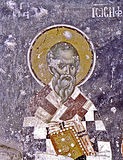
Archbishop
Saint Joseph, Archbishop of Thessalonica, the brother of Saint Theodore the Studite, from his youth labored in asceticism under the guidance of his uncle, Saint Plato, who founded the monastery in Sakkudion. Joseph proved himself to be a true ascetic, and for this he was chosen as Archbishop in the city of Thessalonica.
At that time, the emperor was Constantine, who forcibly tonsured his wife into monastic life and took another woman as his wife, a relative on his father’s side. Joseph denounced the unlawful marriage of Emperor Constantine VI, for which he was brought to Constantinople, subjected to hunger and imprisonment, and exiled to a barren island. Emperor Michael Curopalates later allowed him to return.
However, under Leo the Armenian, Saint Joseph again suffered persecution—for the veneration of icons. He endured torture and imprisonment. Refusing to sign the iconoclastic confession of faith, he was cast into another prison. Later, Michael the Stammerer freed him along with other monks who had suffered for the veneration of icons.
Saint Joseph reposed in the year 830 in the Studion Monastery, where he spent the last years of his life. He is known as a hymnographer; his works include stichera and canons reflecting the spirit of fasting and repentance. His sermons have also been preserved to this day, among which especially notable are his homily on the Exaltation of the Precious Cross, spiritual hymns to the Mother of God, the Forerunner, the angels, the apostles, and Saint Nicholas, as well as stichera of the Lenten Triodion. He also composed a penitential canon for the Sunday of the Prodigal Son, filled with deep contrition for sins.
