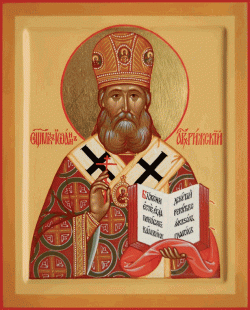
Archbishop
He was born on January 6 (19), 1876, in the village of Ilzessala to a family of Orthodox peasant Latvians. From childhood, he was distinguished by his thoughtfulness and desire to understand the Word of God. In 1887, he entered the Riga Spiritual School, and in 1891, he continued his studies at the Riga Spiritual Seminary. In 1900, he pursued further education at the Kiev Theological Academy, where his resolve to dedicate his life to the service of the Church strengthened. In 1903, he took monastic vows and was ordained as a hierodeacon, and later as an hieromonk. In 1904, he graduated from the academy with honors and became the head of the academic choir.
In 1907, he was elevated to the rank of archimandrite, serving as the inspector of the Lithuanian Spiritual Seminary and the abbot of the Vilnius Holy Trinity Monastery. He led processions with the miraculous icon of the Mother of God, attracting many worshippers. In 1912, he was consecrated as a bishop and appointed as a vicar of the Archbishop of Minsk, Michael, in the city of Slutsk. From 1913, he served in Taganrog at the newly opened Azov Diocese.
After the 1917 revolution, he was appointed to serve in the Tver Diocese, where he quickly established church life. In 1918, he became the Archbishop of Penza and Saransk, where he faced schism and heresy. In 1921, he was appointed Archbishop of Riga and Latvia, gaining broad autonomy rights for the Orthodox Church in Latvia. Possessing spiritual wisdom, he actively worked on restoring church life and the rights of Orthodoxy in the state.
He lived modestly, caring for the poor and needy, making no distinctions between people. In 1934, while at his dacha, he suffered martyrdom and was killed. At his funeral, a multitude of people came to pay their respects to the holy confessor. His grave at the Pokrov Cemetery in Riga became a place of pilgrimage, where healings and divine assistance occurred through the prayers of the saint.
