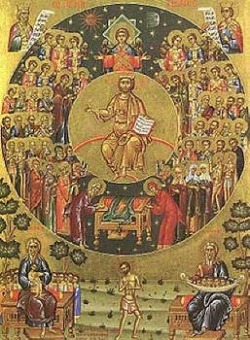
Bishop
An early bishop who labored in Hungary was sent from Constantinople to convert the East Hungarian prince to Christianity after his visit to Tsargrad in 948. Consecrated as an archpastor by the 'Turkic' bishop, he preached among the local population. Thanks to his efforts, Orthodoxy remained in the eastern parts of Hungary for about two centuries after the mass conversion to Roman Catholicism.
The chronicler John Skylitzes reports that Prince Vulosud, pretending to have embraced the Christian faith, arrived in Constantinople, was baptized, and became the possessor of great wealth. Later, Gilaš, the prince of the Turks, also accepted baptism and led many to Christianity. Gilaš remained in the faith and did not raid the Romans, while Vulosud disregarded his covenant with God.
Judging by the information's placement, Hierotheus's mission began between 948 and 954. Vulosud was defeated by the German Emperor Otto I and executed in 955. Djuľa likely ruled in the southeastern part of Hungary, where archaeologists have found many coins and Byzantine crosses, indicating the spread of Christianity among the common people.
The activity of St. Hierotheus in Turkey is indirectly confirmed by an ancient Russian source, which mentions princes who accepted baptism and returned to their land. Apparently, Djuľa accepted the name Stephen at baptism. The Slavic origin of many words in the Christian lexicon of the Hungarian language may indicate that at the initial stage of catechization, the Byzantines used bilingual assistants from among the local baptized Slavs.
