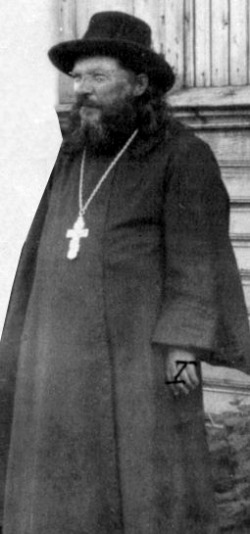
Jacob Vasilyevich Shestakov was born on April 28, 1858, in the village of Kamasino, Perm Province, into the family of a priest. In 1873, he graduated from the Spiritual School, and in 1879 — from the Perm Spiritual Seminary. Since 1879, he worked as a teacher and legal scholar at the zemstvo school, then at the Yukseyev Permyak school. In 1887, he was ordained as a priest and served in various churches, including the church of the village of Khokhlovka and the Church of the Assumption of the Blessed Virgin Mary in Cherdyn. In 1891, he became the archpriest and legal scholar of the Kudymkar school, as well as an observer of Komi-Permyak church-parish schools. In 1899, he left the clergy and moved to Perm, where he continued to teach and collect funds for the construction of churches and monasteries.
Father Jacob organized a commission for the translation of books into the Komi-Permyak language and published literature, including the alphabet and the Liturgy. He also published articles in various journals and collected folklore from the Kama region. In the early 20th century, he drew attention to the problem of preserving cultural heritage and proposed the creation of the Perm Diocesan Church-Archaeological Committee. In 1909, he moved to St. Petersburg, working in the censorship committee of the Holy Synod.
He traveled extensively, gathering facts and describing events, which became the basis for his memoirs 'Chronicle of Father Jacob of Kompa.' In 1918, he was arrested and shot by Red Army soldiers, and there are testimonies about his burial at the Khokhlov Cemetery.
