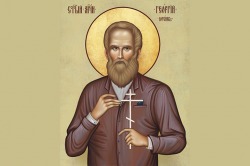
Martyr Georgy Nikolaevich Yurenev was born on December 8, 1887, in Vitebsk, into a noble family. In 1910 he graduated from the Faculty of Law of Saint Petersburg University. He worked as a secretary of the Vitebsk District Court and was elected a city judge of Vitebsk. Georgy Nikolaevich took an active part in the church life of the city.
In May 1920 he was arrested by the Soviet authorities and expelled from Vitebsk. His legal career was closed to him. The former judge settled in Tver, where he worked as a statistician-economist in the city health department and also served as a churchwarden in one of the Tver churches. Later, his niece recalled that “he was very religious, and because of this he had difficulties.”
In 1936 he was arrested again and charged with “participation in a counterrevolutionary church organization.” On August 27, 1936, he was sentenced to three years in labor camps and sent to the Karaganda Corrective Labor Camp, where he worked as an economist.
In September 1937 Georgy Nikolaevich was arrested in Karlag and accused of “belonging to a counterrevolutionary group known as the ‘True Orthodox Church,’ participating in its periodic gatherings, spreading provocative rumors among prisoners and engaging in counterrevolutionary agitation,” and of performing religious rites, “including memorial services for Nicholas Romanov.”
On November 20, 1937, he was sentenced to death by shooting. He was buried in an unknown mass grave. He was glorified by the Jubilee Bishops’ Council of the Russian Orthodox Church in 2000.
