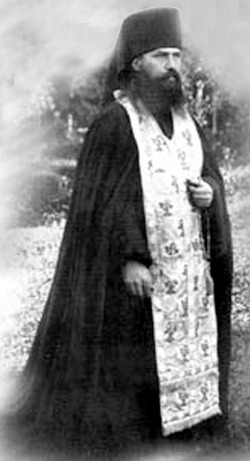
Hieromonk
The Venerable Martyr Anatoly (Smirnov) was a highly educated monk who led a strict ascetic life. He was also an outstanding singer and a remarkable choirmaster, composing sacred music. At the beginning of the 20th century, Father Anatoly, together with other monks of the Glinsk Hermitage, was invited to the Holy Trinity men’s missionary monastery in the Semirechye region of Turkestan. Along with the brethren, he withdrew to the mountainous area of Medeo, where they founded a skete on Mokhnataya Hill in the Aksai Gorge near the city of Verny (Alma-Ata).
In 1909, Father Anatoly was ordained a hieromonk.
At that time, the Iveron-Seraphim convent was established in the city of Verny, and Father Anatoly became the spiritual father of its nuns. In 1913, serious unrest began in the monastery. Then Father Anatoly took his spiritual children from the convent to the skete on Mokhnataya Hill. The monks themselves decided to seek a more secluded place for their ascetic labors and settled at the foot of Mount Kyzyl-Zhar. There they built cells at a distance of about 100 meters from one another. In the Aksai mountains, the monks cut hay, cultivated potatoes, and planted carnations near a spring close to the skete.
In 1916, Father Anatoly directed the bishop’s choir at the Ascension Cathedral in the city of Verny.
After the closure of the Iveron-Seraphim convent, the monastery’s Church of All Saints remained active for some time, where from 1921 Hieromonk Anatoly served. There he also directed the choir and composed music.
In the mid-1920s, Father Anatoly went to Sukhumi, where he lived in the mountains. He corresponded with the nuns of the Iveron-Seraphim convent. Soon they received news from the Caucasus of his arrest and execution.
The Venerable Martyr Anatoly was glorified among the New Martyrs and Confessors of Russia in August 2000 at the Bishops’ Council of the Russian Orthodox Church.
