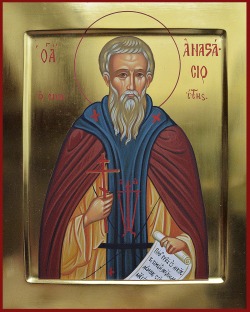
Patriarch
In the thirty-fifth year of the reign of Emperor Justinian the Great, after the death of the Patriarch of Antioch, Saint Anastasius of Sinai ascended to the patriarchal throne.
At this time, turmoil began in the church due to the heretical teachings regarding the body of Christ and the lack of suffering during His Passion. This teaching arose in Constantinople and led to confusion between all faithful, resulting in the deposition of patriarch Eutychius, who opposed the heresy.
Saint Anastasius, having great knowledge of the Holy Scriptures and being steadfast in the orthodox faith, contraddicted the heretics and sent letters warning against their delusions. Emperor Justinian, initially seduced by the new teachings, eventually repented and asked for the returnal of patriarch Eutychius.
After the death of Justinian, his nephew Justin the Younger deposed Saint Anastasius from the throne, bringing unjust accusations against him. The saint was falsely accused of mismanaging church funds and slandering the emperor. Justin, being offended by Anastasius for refusing to support his ascension to the throne, sought for long a reason for his deposition.
After the deposition of the saint, Gregory was appointed to the patriarchal throne of Antioch. Saint Anastasius, after twenty-three years of exile, was restored to his throne during the reign of Emperor Maurice. At this time, the pope of Rome was Saint Gregory the Great, who maintained a close spiritual bond with Anastasius.
Blessed Anastasius, having lived six years after his return, departed to the Lord in the fourteenth year of the reign of Emperor Maurice. After him, another Anastasius ascended to the patriarchal throne, who was killed by the Jews during the reign of Emperor Phocas and is venerated as a martyr.
Today, there are two saint with the same name, known as “Anastasios of Sinai.” The first was the patriarch of Antioch, while the second was the abbot of mount Sinai, who died during the reign of Emperor Heraclius.
