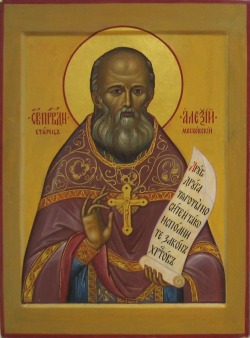
Protoiereus
Saint Righteous Alexy Mechyov was born on March 17, 1859, into the pious family of the choir director (regent) of the cathedral Chudov Choir, and he was named in honor of Alexy, the Man of God. From his parents the boy learned a living faith in God, love, and a kindhearted attitude toward people.
After graduating from the Moscow Theological Seminary, Alexy wanted to study medicine, but his mother, who wished to see her son become a priest, opposed this. Later, Alexy was grateful to his mother, for in the priesthood he found his true calling.
On October 14, 1880, he was appointed psalm-reader at the Church of the Sign. The rector of the church was strict and demanded much of him, but Alexy endured everything without complaint.
In 1884 he married Anna Petrovna Molchanova, and their marriage, in which five children were born, was very happy.
In the spring of 1893, Deacon Alexy Mechyov was ordained to the priesthood for the Church of Saint Nicholas in Kleniki. There were very few parishioners in the small, modest church, since well-known churches were nearby. But Father Alexy did not lose heart. Surrendering himself to God’s will, for eight years he served the Divine Liturgy every day in an empty church almost alone, yet he served as though the храм were full of praying people. In time, those who were sorrowful and burdened with grief began to come to this church, and from them spread word of a good shepherd.
Alexy’s wife Anna suffered from a severe heart illness and reposed in 1902. After her death, Alexy continued to serve, drawing to himself many people who were seeking consolation and help.
Father Alexy possessed the gift of spiritual insight and helped people by revealing to them their inner problems and guiding them onto the path of repentance. He founded a parish school and a shelter for children. His sermons were simple and sincere; they touched the hearts of those who listened.
Father Alexy reposed on June 9/22, 1923. His funeral was attended by many, and people came to bid him farewell. After his death, his grave became a place of pilgrimage, where people sought help and consolation.
