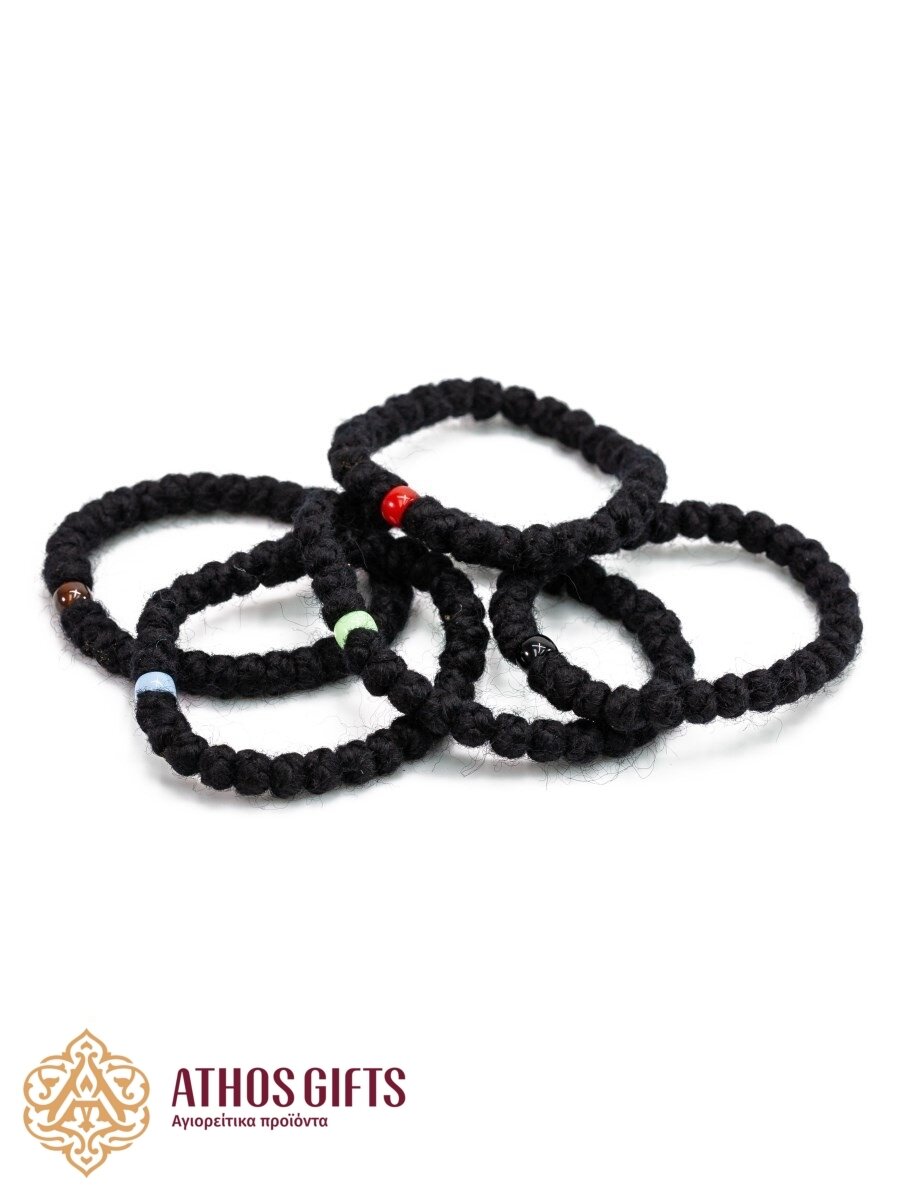
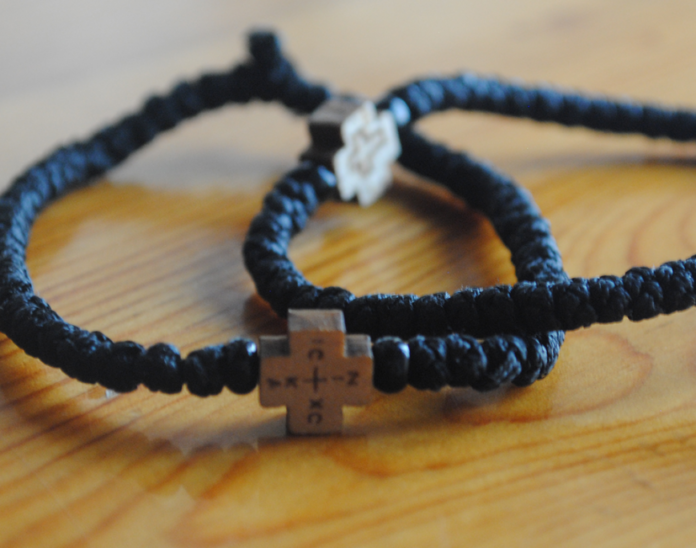
The prayer rope is an aid for concentration and prayer, used both by the clergy and by all faithful. As its name indicates, it is woven from rope tied into a series of knots. It has a sacred purpose, to support prayer. However, it is often misused, treated as a charm with magical powers or worn as a mere bracelet. Such practices oppose the spirit and teaching of the orthodox church.
According to tradition, an ascetic used to do many bows and prayers, as is required in monastic life. To keep count, he used a simple rope with a few knots. However, the devil repeatedly broke it, forcing the monk to knit it over and over again. At last, an angel of the Lord appeared to him and taught him a new way of tying the rope. Each knot would be formed in the shape of a cross, with nine small crosses woven into it in honor of the nine orders of angels. From then on, the devil was powerless to undo the knots, for he trembled at the sign of the Cross.
Today, prayer ropes are made in various forms, depending on their intended use. A small prayer rope worn on the finger usually has 12 knots, in remembrance of the twelve Apostles. The one worn on the wrist may have 33 knots, symbolizing the years of Christ’s earthly life, while larger ones are made with 50, 100, 300 knots or more.
The prayer rope is “a legacy left to us by our holy fathers,” as Saint Paisios used to say. This legacy does not lie merely in the object itself, but primarily in the way of prayer they handed down to us, that is the mental prayer, commonly known as the prayer of Jesus Christ.
For the Holy Fathers of Mount Athos, the mother and teacher of this prayer has been none other than the Most Holy Theotokos, our Lady and Mother of all monks. During her earthly life she glorified God unceasingly. Her entire being was a life of continual prayer. Thus, she is regarded as the one who first revealed and inspired this path of ceaseless devotion.
The invocation of the name of the Lord—“Lord Jesus Christ, have mercy on me”—expresses the whole of Orthodox ascetic theology. Through it, man is called to be transformed into a dwelling place of the Holy Spirit. A shining witness to this truth is Saint Gregory Palamas, the 14th-century defender of hesychasm, whose life and teaching left to the Athonite monasticism a profound theological heritage that remains alive to this day.
The core of the hesychastic movement is that man, through the purity of his heart and unceasing prayer, may participate in the uncreated actions of God, though not in His incomprehensible essence. The living presence of the Holy Spirit continues unchanged to this very day, manifesting itself in the sacramental life of the Church and in the radiant lives of saints.
How the Prayer Rope Is Used in the Daily Prayers of all Christians?
The prayer rope is a means of strengthening prayer at all times and in every place. Yet if one desires to devote themselves more intensely or systematically to the mental prayer, it is essential to do so with the blessing and guidance of a spiritual father. His discernment helps ensure that our efforts bear fruit and that we are not misleaded.
In practice, the believer usually holds the prayer rope in the left hand, so that the right hand remains free to make the sign of the Cross. Passing the rope gently through the fingers, one grasps each knot in turn, reciting the prayer: “Lord Jesus Christ, have mercy on me, a sinner.”.jpg)
Other short phrases may also be used, such as:
“Most Holy Mother of God, save us,”
“Holy [name of the saint], intercede for us,”
“Lord Jesus Christ, grant rest to Your servants.”
In this way, the prayer rope becomes a companion and guide, helping us to keep a daily rule of prayer.
It is sometimes mistakenly thought that the Jesus Prayer is selfish, since the believer prays in the first person, asking for his own salvation. Yet Saint Porphyrios of Kavsokalyvia explains: “From the moment we are baptized, we become members of the Body of Christ. Therefore, the words ‘have mercy on me’ do not refer only to ourselves individually, but to a living part of the Body of the Lord!”
Mental prayer can be practiced at all times, day and night. Elder Ephraim of Arizona, drawing from his deep experience as a disciple of Saint Joseph the Hesychast, often emphasized the decisive importance of cultivating this prayer. He would remind his spiritual children: “Prayer will save the world.” He taught everyone that it should be practiced without ceasing, first aloud, until it becomes a habit, and then silently in the mind, until divine Grace descends and the prayer moves from the mind into the heart.
Saint Paisios, as well, highlighted the same truth: “Hold the prayer rope so that you do not forget the prayer, which you must continually cultivate within, in your heart. When you leave your cell, remember that the enemy is ready to attack. Therefore, imitate the good soldier who, when leaving the barracks, always has his weapon at hand. The prayer rope has great power. It is the monk’s weapon, and its knots are the bullets that crush demons.”