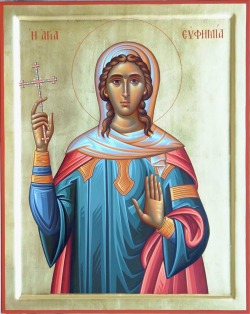
Saint Euphemia the Great Martyr was born and lived in Chalcedon during the reign of Emperor Diocletian.
Her parents, Philophron and Theodoriana, were devout Christians and ensured that their daughter was raised according to the principles of the Christian faith. She herself grew into a virtuous person endowed with rare gifts. When Priscus, the pagan proconsul of Asia Minor, ordered the inhabitants of the region to attend a festival held in honor of the god Ares, the saint refused to take part. As a result, she was arrested and cast into prison.
During her imprisonment, she endured many tortures. Nevertheless, she never renounced her faith in Christ, remaining steadfast in her love and devotion. In the end, she was thrown to wild beasts and met a tragic death at the claws of a bear.
Her relics were preserved and venerated by the faithful. After they were transferred to Constantinople, they began to exude pure myrrh, while the saint continued to work miracles, protecting and healing those who came to her with faith.
During the period of Iconoclasm, her relics were stolen and cast into the sea by the Emperor Leo the Isaurian. Yet, through God’s providence, they were miraculously recovered and transferred to Lemnos, where a church was built in her honor.
The memory of Saint Euphemia is celebrated on July 11 and September 16.
