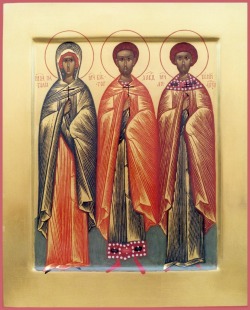
Saint Euphemia, the Great Martyr, daughter of the Christian senator Philophron and Theodosia, suffered for Christ in Chalcedon around the year 304. At that time, the governor Priscus summoned the inhabitants to a pagan festival, threatening torture to those who would not offer sacrifice to the idol Ares. Forty-nine Christians, among whom was Euphemia, hid in a house where they secretly held the Divine Service. They were arrested and tortured, but none renounced their faith. Euphemia was separated from the others and, despite persuasion and torture, remained faithful to Christ.
The saint prayed to the Lord, and despite the cruel torments, she remained unharmed. She was thrown into a heated furnace, but two Angels protected her, and she remained intact. Then she was sent to be devoured by beasts, but no beast touched her, except for a she-bear, which inflicted a small wound. The saint died from this wound, and at that moment an earthquake occurred, frightening the guards and spectators, which allowed her parents to bury her with honor not far from Chalcedon.
On her grave, a magnificent temple was erected, where the sessions of the Fourth Ecumenical Council took place in 451, during which the saint miraculously confirmed the Orthodox confession. Her relics were transferred to Constantinople around the year 620, and during the iconoclastic heresy, they ended up in the sea but were retrieved by pious sailors and later returned to Constantinople in 796.
