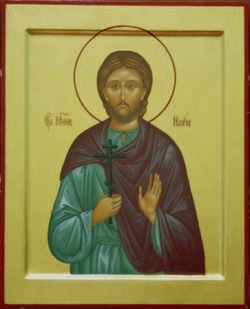
Saint Nicholas Probatoff was born in 1874 in the village of Ignatievo near the city of Kadom in the Tambov province. He was the youngest son of priest Alexander Nikolaevich Probatoff and his wife Elikonida. Nicholas received his education at the Kasimov Spiritual School and the Tambov Theological Seminary, experiencing financial difficulties. After graduating from the seminary, he married Varvara Algebristova and went on a wedding pilgrimage to the Sarov Monastery.
In 1899, Nicholas was ordained as a presbyter and appointed as the second priest in the church of the village of Temirevo. In 1906, he received a parish in the village of Aglomazovo, where he served in a wooden Epiphany church built in 1779. Nicholas renewed the iconostasis and organized a church choir, serving with inspiration and reverence.
With the onset of World War I, Nicholas, despite having three children, went to serve as a regimental priest in the First Bakhmut Regiment. Upon returning in 1917, he bitterly noticed that priests had become unnecessary.
After the revolution, when persecutions against the Church began, Nicholas defended church books from confiscation. In 1918, when the peasants decided to resist the Bolsheviks, he blessed them for the struggle. However, after an incident with the Red Guards, a punitive detachment was sent to the village. Nicholas, not wanting to leave his parish, stayed with his son Alexander.
The punitive forces arrested Nicholas and subjected him to torture. He did not renounce his faith, even when he was beaten. The last liturgy he served was on the feast of the Kazan Icon of the Mother of God. Before his execution, he prayed for his tormentors, asking the Lord for forgiveness for them. As a result of the shooting, he was killed, remaining faithful to Christ until the end.
Nicholas's body was found and buried by the peasants, despite the prohibitions of the punitive forces. His wife appealed to the authorities for permission to bury him, and priests from neighboring parishes came to serve a panikhida. Nicholas was buried near the church, and his memory remained in the hearts of the faithful.
