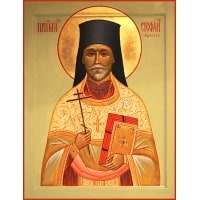
Hieromonk
Saint Stephen (Kushkov) was born on December 10, 1870, in the town of Vyshny Volochyok, in the Tver province. After completing his education, he joined a monastic community, where he served as a chanter until 1898, when he was eventually tonsured a monk.
The political upheaval that followed the Revolution of 1917 found him in the city of Petropavlovsk. Cut off from his homeland, he began to serve the Church as a chanter. After the army withdrew, he moved to the Kuban region, until he was able to return to his homeland. There, he served at the church of the village of Nikolskoye, in the Belozersky district.
As time passed, the persecutions against the faithful and the clergy became more intense. In 1934, after the feast of Pascha, the saint went from house to house in order to provide people with the Holy Communion. At that time, he was threatened with arrest if he continued his activity.
In 1936, the Soviet government launched a new campaign against the Orthodox Church, brutally persecuting the clergy.
Saint Stephen was arrested on August 7, 1937. During the interrogation, he denied all accusations of counter-revolutionary activity, stating that he visited the homes of the faithful in order to perform a religious sacrament and not to engage in anti-Soviet propaganda. Nevertheless, he continued to be falsely accused.
On September 13, the NKVD sentenced him to death. The saint was executed on September 17, 1937. In 2000, he was canonized by the Russian Church, which recognized him as a New Martyr and Confessor of the faith.
