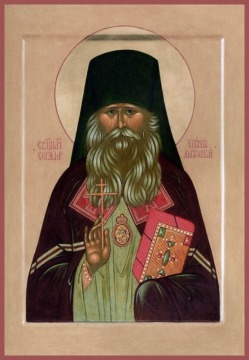
Bishop
Hieromartyr Seraphim (in the world Nikolai Ivanovich Zvezdinsky) was born on 7 April 1883 in Moscow into the family of a priest. His father, Ivan Gavrilovich, was originally an Old Believer, later joined the Edinoverie and became a priest. His mother, Evdokia Vasilievna, died when he was two years old. From childhood Nikolai loved church services and singing.
He graduated from the parish school in 1895, the Zaikonospassky Theological School in 1899, the Moscow Theological Seminary in 1905, and the Moscow Theological Academy in 1909 with the degree of Candidate of Theology. In 1902, having fallen gravely ill, he recovered after praying to St. Seraphim of Sarov. On 26 September 1908 he was tonsured a monk with the name Seraphim.
From 10 December 1909 he taught Church History at the Bethany Theological Seminary, and from 21 September 1912 he taught homiletics at the Moscow Theological Seminary. On 3 January 1920 he was consecrated Bishop of Dmitrov. He preached much and celebrated the liturgy, and founded the Brotherhood of the Life-Giving Cross of the Lord.
On 12 December 1922 he was arrested and sentenced to two years of exile in the Zyryan region. In 1925 he returned to Moscow, then lived in Diveyevo. On 22 September 1927 he was arrested again, then released and summoned to Moscow to Chekist E. A. Tuchkov, who was involved in the campaign against the Church. Tuchkov proposed that he cooperate with the authorities and with Metropolitan Sergius (Stragorodsky), who by that time had already issued his Declaration under threat of executions of clergy. Seraphim refused the offer and submitted a petition to Metropolitan Sergius for his dismissal from active service, which was granted in 1928.
From October 1927 he lived in the town of Melenki of the Vladimir Governorate. He regarded the activity of Metropolitan Sergius as Deputy of the Patriarchal Locum Tenens negatively, yet did not join any organized opposition; he belonged to the so-called “non-commemorators.” Believers from Dmitrov and Moscow visited him in Melenki.
In 1932 he was arrested again, brought to Moscow, and sentenced to three years of exile in Kazakhstan. In January 1935 he was sent to Siberia, where he remained after the end of his exile term.
On 24 June 1937 he was arrested by the NKVD and accused of participating in a counterrevolutionary organization. On 23 August 1937 a “troika” sentenced him to be shot. Official reports claimed that he had been sentenced to a labor camp, where he allegedly died. In August 2000 he was canonized among the New Martyrs of Russia.
