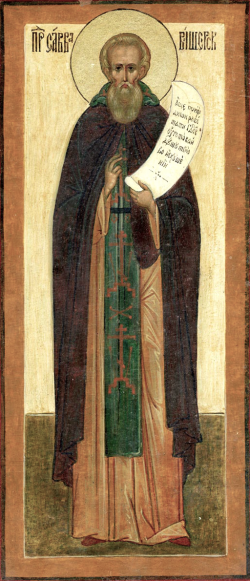
Saint Savva, originally from the Tver principality, distinguished himself by a virtuous life from a young age. He took monastic vows and lived in Tver monasteries, performing obediences with extraordinary humility. Avoiding human glory, he withdrew into obscurity and went to Mount Athos, where he perfected himself in spiritual life.
Upon returning to Russia, he came to the Vyshera River, established a cross, and began to lead a hermitic life. His prayers and asceticism attracted the attention of the local inhabitants, and soon Archbishop John learned about him. Savva humbly responded to the reproaches of the archbishop's messenger, and soon the archbishop himself came to him, admiring his spiritual life.
Saint Savva founded a monastery, built cells for the brethren, and erected a church in honor of the Ascension of the Lord. He continued to labor and care for the spiritual life of the monks. Savva spent his time in fasting and prayer, even on the pillar where he asceticized until his death.
In his seventieth year, he fell ill and, preparing for death, left instructions to the brethren about humility and the observance of monastic vows. The venerable one peacefully reposed on October 1, 1460, instructing his disciples to have a simple burial.
After his death, the monastery continued to prosper, and soon miracles began to occur at his grave. The relics of the venerable one were transferred to a new church, and a feast was established in his honor in the Orthodox Church. Saint Savva became known as the New Novgorod Miracle Worker, and his memory is honored to this day.
