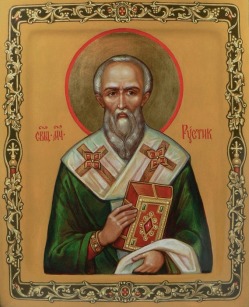
Presbyter
The Holy Martyrs Dionysius the Areopagite, Bishop of Athens, Presbyter Rusticus, and Deacon Eleutherius were killed in Gaul's Lutetia in the year 96 during the persecution under Emperor Domitian. Dionysius, who received a classical education in Athens, became a Christian after the preaching of the Apostle Paul. He was appointed Bishop of Athens and was present at the burial of the Most Holy Theotokos.
After the death of the Apostle Paul, Dionysius went to preach in the western countries, converting many to Christ. In Gaul, during the persecution of Christians, all three confessors were captured and beheaded. Saint Dionysius, taking his head in his hands, walked with it to the temple and only there fell dead. His remains were buried by a pious woman named Catulla.
The writings of Saint Dionysius the Areopagite hold great significance for the Orthodox Church. Four books have survived: "On the Heavenly Hierarchy," "On the Ecclesiastical Hierarchy," "On the Names of God," and "On Mystical Theology." The book "On the Heavenly Hierarchy" expounds the Christian teaching about the Angelic world and consists of nine Angelic orders.
The book "On the Ecclesiastical Hierarchy" is a continuation of "On the Heavenly Hierarchy." It describes how Divine grace descends into the world through the holy Church Sacraments. The book "On the Names of God" outlines the ways of knowing God, while "On Mystical Theology" teaches that to know God, one must approach Him through prayer.
The writings of Saint Dionysius the Areopagite, known as the "Areopagitics," have exceptional importance in the theology of the Orthodox Church and have been known since the 6th-7th centuries. The teaching of Saint Dionysius on spiritual hierarchies and the deification of human nature became known through the "Theology" of Saint John of Damascus and was translated into the Slavic language in the 14th century.
