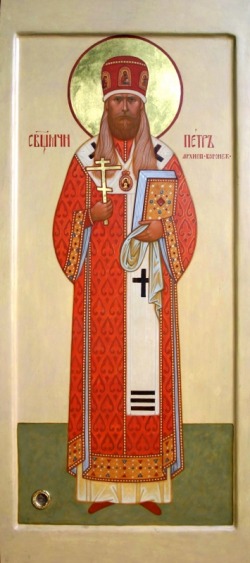
Archbishop
In the world, Vasily Konstantinovich Zverev was born on February 18, 1878, into the family of a priest. His father, Konstantin Zverev, served in the parish church in Vishnyaki near Moscow and was later appointed the rector of the Church of St. Alexander Nevsky. In 1895, Vasily graduated from gymnasium and entered the historical and philological faculty of Moscow University, and then was accepted into the Kazan Theological Academy.
In 1900, he was tonsured into monasticism with the name Peter and was ordained as a hieromonk. In 1902, he was awarded the degree of Candidate of Theology. After graduating from the academy, he was appointed a teacher at the Oryol Theological Seminary, then transferred to the Knyaz-Vladimir Church at the Moscow Diocesan House and became the inspector of the Novgorod Theological Seminary.
In June 1909, he was appointed the rector of the Belev Spaso-Preobrazhensky Monastery in the Tula Diocese. In 1910, he was elevated to the rank of archimandrite. During World War I, a hospital was opened in the monastery. In October 1916, by the order of the Holy Synod, he was directed to the disposal of Bishop Evdokim of the Aleutian Diocese, but he went to the front, where he served as a preacher until the February Revolution of 1917.
In 1917, he was appointed the rector of the Assumption Monastery in Tver, where he was arrested as a hostage. In 1919, he was consecrated as Bishop of Balakhna, vicar of the Nizhny Novgorod Diocese. He settled in the Pechersky Monastery in Nizhny Novgorod, where he blessed the strict observance of the service rule.
In May 1921, he was arrested, which caused a strike among workers. After his release in January 1922, he served in the Church of the Marfo-Mariinsky Convent and in the Church of Christ the Savior. In 1922, he was appointed Bishop of Staritsa, where he also actively served and helped the starving.
In 1922, after addressing the flock about the schism, he was arrested and sentenced to exile in Turkestan for two years. In 1924, he returned to Moscow and managed the Moscow Diocese. In 1925, he was sent to Voronezh, where he assisted Metropolitan Vladimir.
In 1926, he was elected Archbishop of Voronezh. He successfully opposed the Renovationist schism, attracting believers to worship. However, in October 1926, he was arrested again and sentenced to 10 years in the Solovetsky camp.
In Solovki, he served in the church and was elected head of the Orthodox clergy. In 1929, he fell ill with typhus and passed away on February 7. Initially buried in a mass grave, he was later reburied with all church rites.
The honorable relics of the holy martyr Peter were found on June 17, 1999, and canonized in 2000 for public veneration. The relics were transferred to the Solovetsky Monastery and then to the Alexeyev-Akatov Monastery in the city of Voronezh.
Author's works: “Exegetical Analysis of the First Two Chapters of the Epistle of Apostle Paul to the Hebrews.”
