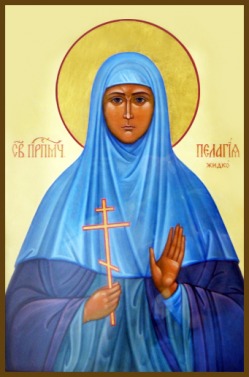
The martyr Pelagia was born in 1897 in the village of Kucheryaevka, Bobrovsky district of Voronezh province, in the family of peasant Stepan Stepanovich Zhidko. She decided to dedicate her life to the service of the Lord. In the 1920s, monasteries in Voronezh province were closed, and monks dispersed to villages where Christian communities gathered. Persecution of the Russian Orthodox Church did not cease, and by the end of 1937, there were no priests left in the Buturlinovsky district, but Christians continued to gather for prayer.
On November 27, 1937, Pelagia was arrested. During the interrogation, she replied that she did not consider herself guilty of counter-revolutionary propaganda, as she did not engage in it. She only expressed dissatisfaction with collective farm life. The investigation accused her of active participation in a counter-revolutionary organization aimed at overthrowing the Soviet government.
On December 15, 1937, the NKVD troika sentenced Pelagia to ten years of imprisonment in a labor camp. In 1942, after many prisons, she arrived at Karlag in Kazakhstan, already completely blind. Pelagia Zhidko passed away on June 26, 1944, at the site of Karlag in Djartas and was buried in an unmarked grave at the camp cemetery.
