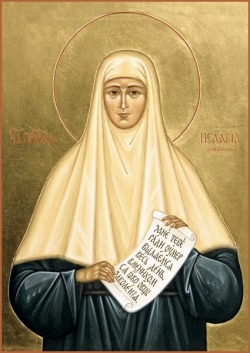
Saint Pelagia was born into a peasant family in the village of Arga, Tambov province. From the age of fourteen, she labored for nearly three decades in the Seraphimo-Diveevo Monastery, serving as a seamstress and a mower. After the revolution, the monastery was transformed into a labor artel. In late summer 1919, the authorities proposed sending some of the nuns to harvest fields belonging to the families of Red Army soldiers. The monastery council indicated that the sisters were exhausted from hunger and could not go to work in the fields. Nun Pelagia, being a member of the council, tried to defend the sisters and refused to comply with the representative's demands, for which she was arrested and sentenced to three years in prison. After an investigation, the nuns were released, and the monastery council was restored to its rights. In 1927, a campaign began to liquidate the monastery, with widespread searches and arrests. Nun Pelagia and her elder sister, Nun Martha, began to live near churches. On November 20, 1937, Nun Pelagia was arrested again and accused of conducting 'counter-revolutionary agitation.' By the decision of the NKVD troika on December 14, 1937, she was sentenced to imprisonment in the Karaganda corrective labor camp for eight years. Despite the harsh conditions, her work was noted for its quality in the evaluations. On November 3, 1944, on the eve of the feast of the Kazan Icon of the Mother of God, Nun Pelagia died in the camp hospital and was buried in the camp cemetery. On October 6, 2001, it was decided to include her in the canonized assembly of the New Martyrs and Confessors of Russia of the 20th century.
