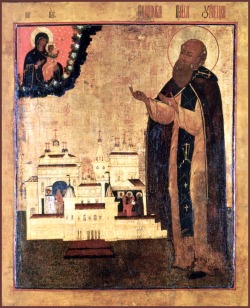
Ηegumen / Abbot
Saint Paisios of Uglich was born in the village of Bogorodsk, near the city of Kashin. His father, John Gavrenev, served Prince Andrei Vasilyevich. During his childhood, he learned to read and write and began visiting the Holy Monastery of Kalazin, where he came to love the monastic life. At the age of ten, he was left an orphan. He was then taken in and raised at the Holy Trinity Monastery of Kalazin, where he became a monk and received the name Paisios.
Under the guidance of his uncle, Saint Makarios, he practiced the virtues of obedience, fasting, and prayer. Soon, ten monks gathered around him, leading to the foundation of a new monastery on the left bank of the Volga River, where there was built a wooden church dedicated to the Baptism of the Lord. Archbishop Tikhon of Rostov ordained him to the priesthood, while he was later chosen as abbot of the new monastery, which he governed with wisdom and discipline.
Prince Andrei Vasilyevich supported the monastery through generous donations. In 1482, he consecrated a stone church in honor of the Most Holy Theotokos. Saint Paisios also cared for the imprisoned princes John and Demetrios, strengthening their spirit and their faith in the heavenly Kingdom of God.
Among the gifts granted to him, there was the grace of working miracles. Through his prayers and faith, he healed the sick and those possessed by demons. During a great fire in Uglich, he carried along the city the wonderworking icon of the Most Holy Theotokos so that the disaster ceased. He also prayed during a flood, preventing the waters from overwhelming the church.
Saint Paisios lived in humility and obedience, becoming a model of grace for his brethren. During the final days of his life, he gathered the monks together, comforted them, and entrusted the care of the monastery to Makarios.
He reposed on June 6, 1504. Many miracles followed after his burial.
In 1609, the monastery was destroyed by invaders. However, a few years later it was restored through the efforts of the people of Uglich.
