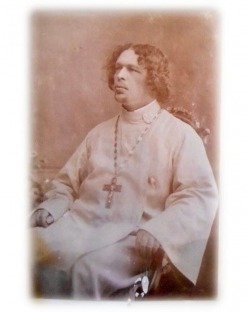
Presbyter
He was born on May 10, 1893, in the village of Blagoveshchenie, Smolensk province, in the family of deacon Iakov Kobranov. In 1913, he graduated from the Smolensk Theological Seminary and entered the Faculty of Law at Warsaw University. In 1918, he found himself in Crimea, where he initially served as a singer in the Simferopol Cathedral and later as a subdeacon to the Taurida Archbishop. In 1920, he was ordained a deacon, and in 1921 – a priest. During the retreat of Wrangel's army, he remained in Russia and served in a church in one of the villages of Melitopol district. In 1922, he served in the Novospassky Monastery in Moscow, and in 1923, he was assigned to a church in the village of Voskresenskoye, Moscow province.
In 1925, he was appointed rector of the Church of the Holy and Life-Giving Trinity in Kozhevniki, Moscow, and elevated to the rank of protodeacon. The church, built in 1689, was experiencing decline due to the construction of factories in the area. In 1925, the church was closed, but Father Nikolai created a vibrant parish around it, calling on parishioners for help in its restoration.
Father Nikolai often served and conducted theological discussions, inviting renowned professors. He organized a society of permanent donors for the repair and beautification of the church. In 1929, he was arrested and imprisoned in Butyrka prison, where he was interrogated. He was accused of organizing a group of believers to conduct anti-Soviet propaganda. On November 20, 1929, the Special Meeting of the OGPU sentenced him to three years in a concentration camp, and he was sent to the Solovetsky camp.
After his release in 1935, he returned to the village of Kukarino. On April 27, 1936, he was arrested again and imprisoned in Butyrka prison. The investigation lasted a month, and he was accused of organizing an illegal monastery and conducting anti-Soviet agitation. On May 21, 1936, he was sentenced to five years in a correctional labor camp. In Ukhtpechlag, he continued a hunger strike, demanding solitary confinement. On September 29, 1937, the NKVD troika sentenced him to death, which took place on December 31, 1937. He was buried in an unmarked grave.
During his imprisonment, he sent poems to his spiritual children, calling them to prayer in difficult times.
