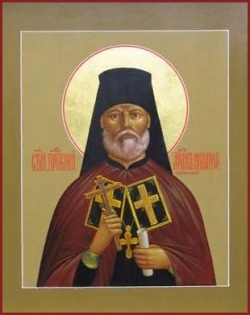
Archimandrite
He was born on March 13, 1870, in the village of Vyzheles in the Ryazan province to a peasant family of Mikhail Morozkin, and was named Nikifor at baptism. In 1888, he left his parental home and settled in Orenburg, where he initially sang in the church and later took on the duties of a psalmist. In 1899, he joined the brotherhood of the Nikol-Perevinsky Monastery. On November 25, 1903, he was tonsured into monasticism with the name Nikanor, and on January 24, 1904, he was ordained as a hierodeacon. On October 5, 1909, he was ordained as a hieromonk.
On February 27, 1917, he was appointed spiritual father of the brotherhood. On August 24, 1920, he was appointed head of the chapel of the Iveron Icon of the Mother of God in Moscow. In 1921, the chapel was robbed, and he, along with members of the church council, was arrested, but the court acquitted them. He returned to the Nikol-Perevinsky Monastery, where he was appointed abbot. In 1923, he was elevated to the rank of igumen and became a member of the Moscow diocesan assembly.
He was arrested on February 2, 1932, and imprisoned in Butyrka prison. During interrogations, he asserted that he did not conduct anti-Soviet agitation. On March 13, 1932, the OGPU troika sentenced him to five years of exile in Kazakhstan, where he remained until July 1, 1934. After his release, he was not allowed to live in Moscow, and he settled in the village of Spas-Ostashovo, serving in the Spasskaya church.
He was arrested again on March 26, 1938, accused of counter-revolutionary activities, but he did not admit guilt. On June 14, 1938, the NKVD troika sentenced him to death by shooting. Archimandrite Nikanor (Morozkin) was shot on July 1, 1938, and buried in an unmarked common grave at the Butovo shooting range near Moscow.
