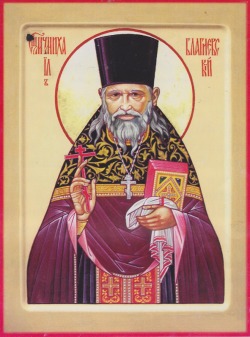
Presbyter
Mikhail Kobozev was born on February 4, 1874, in the village of Spas-Leonovshchina in the Yegoryevsk district of the Moscow province. His parents were Deacon Ioann Lvovich Kobozev of the Church of the Transfiguration and Maria Gavrilovna Kobozeva. He was baptized in the same church on February 5.
His godparents were his father’s brother and sister, Dmitry and Maria Kobozev. As was the case for most children of clergy, Mikhail’s future path was largely predetermined—he was expected to pursue a spiritual vocation.
In 1892, he completed the full course at the Skopin Theological School, with the right to enter the Ryazan Theological Seminary. However, Mikhail chose practical work over further study. For two years he served as a trainee at the parish school in the village of Dymovo in the Skopin district. In 1894, he received certification as an elementary school teacher and began his independent teaching career at the parish school in the village of Murzinka in the Ryazan province. In 1897, he attended church singing and teaching courses, which he completed with great success.
In 1898, a new stage began in Mikhail Kobozev’s life. From that time, his судьба was connected with the Ranenburg region. He was ordained a deacon by Bishop Meletius of Ryazan and Zaraysk and assigned to the Church of the Holy Spirit in the village of Blagie in the Ranenburg district. At the same time, Father Mikhail, like many clergy, taught the Law of God to children at the parish school.
In 1910, Father Mikhail was transferred as a deacon to the Ascension Church in Ranenburg. His large family moved to the town, where he lived with his wife Sophia Nikolaevna and their six children in a small house on Ploshchadnaya Street. He continued his teaching work, and in 1913 he was appointed instructor of religious education at a local zemstvo school. For his diligent and exemplary service, he was awarded a silver medal commemorating the 25th anniversary of church schools and received official gratitude from the Ryazan diocesan school council. Soon afterward, he was ordained a priest.
The year 1917 became a turning point in Russia’s history. After the October Revolution, persecution of the Russian Orthodox Church intensified dramatically. In these conditions, Father Mikhail sought to unite the faithful around the Church. Alongside religious education, he believed that one of the main goals of the parish community should be charitable work based on Christian brotherhood. The pressure on the Church increased year by year: taxes were raised, church property was confiscated, and churches were closed. The first victim of this campaign in Ranenburg was the Ascension Church where Father Mikhail served. A Bolshevik district committee was located opposite it, and the authorities deemed such proximity unacceptable. The church was closed.
In 1932, Father Mikhail was forced to leave his family in Ranenburg and take a parish in the neighboring Novo-Derevensky district, in the village of Dmitrievsky Borovok. The following year, he was elevated to the rank of archpriest by Archbishop Juvenaly of Ryazan.
The wave of mass repression reached its peak in 1937. At the end of October, eight clergy from the Novo-Derevensky district were arrested and accused of forming a counter-revolutionary organization. The reason for their arrest was that on July 1, the feast day, all the priests of neighboring parishes had gathered in the village of Zimarovo to venerate the wonderworking Bogolyubsk-Zimarovo Icon of the Mother of God. At that time, Father Mikhail Kobozev was serving again in the village of Blagie, where he had begun his ministry. He was specifically accused of conducting anti-Soviet and counter-revolutionary activities aimed at undermining government measures and inciting collective farmers against the Soviet system.
The fate of the arrested clergy was predetermined. The investigation was merely a formality, carried out to maintain appearances before bringing charges against them.
The investigator persistently demanded that Father Mikhail give self-incriminating testimony against himself and other priests. He behaved with dignity, fully aware that a careless word could endanger his fellow clergy.
The investigation proceeded with striking speed; all legal procedures took just over a month. Soon an обвинительное заключение was issued. In early December 1937, by decision of the NKVD troika for the Ryazan region, Archpriest Mikhail Kobozev was sentenced to death.
Page 146 of the investigation file contains three typed forms titled "Extract from the Act," in which only the name and date needed to be filled in. The last of them reads: "The decision of the NKVD troika for the Ryazan region of December 6, 1937, concerning Kobozev Mikhail Ivanovich, was carried out on December 23, 1937, at ‘…’ hours. Signatures..." The sentence was carried out in the prison of the city of Ryazhsk. The place of Father Mikhail’s burial remains unknown.
