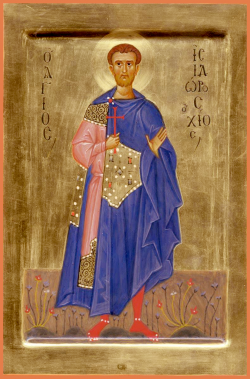
During the first year of the reign of Emperor Decius, a decree was issued for the conscription of young men. At that time, there lived on the island of Chios a young man named Isidore. He was Christian who led a God-pleasing life and served in the regiment of Numerius.
Soon afterward, the emperor commanded that all should worship the Roman gods, thus initiating a severe persecution of Christians. The centurion Julius, being aware of Saint Isidore’s faith, informed Numerius, who ordered his arrest. When brought before him, Isidore openly confessed his faith in Christ and steadfastly refused to offer sacrifices to the idols. For this, he was subjected to cruel tortures, which he endured with unshaken courage, continually affirming his belief in the one true God.
Seeing that the saint remained firm in his confession, the governor ordered that his tongue be cut out. Yet even then, Isidore’s faith did not waver. At last, he was sentenced to be beheaded. Before his death, he prayed fervently and, bowing his head, received the crown of martyrdom for confessing the name of Jesus Christ.
The saint’s body was left unburied, until one of his friends, Ammonius, secretly buried him with reverence. Later, the relics of Saint Isidore were discovered by a pious woman named Myropia and placed in a church for the veneration of the faithful. In his honor, a church was built, and a feast was established to celebrate his holy memory.
