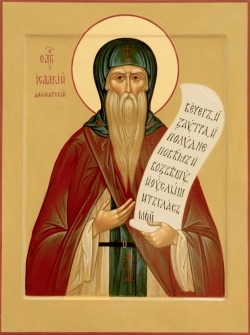
Ηegumen / Abbot
After the discovery of the life-giving Cross of the Lord and the reign of Emperor Constantine the Great, his successor, led by Arianism, launched fierce persecutions against Christians. At that time, God’s providence sent monk Isaac to Constantinople in order to strengthen and encourage the faithful. The saint prayed earnestly for God’s mercy and warned the emperor to reopen the churches so that all could freely worship the one and true God. In return, he promised that the Lord would stand beside him in the approaching battle and grant him victory over his enemies.
Despite the saint’s warnings and requests, the emperor remained unmoved. He even ordered Isaac to be thrown into a marsh, from which he was miraculously saved, through the intervention of the angels of the Lord. Isaac returned and warned the emperor once more. However, once more his words were ignored. Soon afterward, a battle broke out against the barbarians who, by God’s allowance, won and brutally killed the emperor.
Following the emperor’s death, Isaac was released and honored as a prophet. The new emperor, Theodosius the Great, having heard of the saint’s spiritual gifts, called him to the palace and, full of reverence, asked for his prayers. Isaac guided the emperor toward a devout life and helped him confront Arianism, ultimately leading to the exile of the heretics from Constantinople.
Wishing to continue his service to the Lord, Saint Isaac remained in Constantinople, where he founded a monastery and became its abbot, teaching the monks and all the faithful the path of piety. He was merciful to the poor and devoted to works of charity. When he reached old age, he entrusted the abbacy to another and peacefully fell asleep in the Lord, leaving behind a rich spiritual legacy.
He was buried with great honor. His holy relics were placed in the church of Saint Stephen the First Martyr. His presence remains there, interceding for all of us before the Holy Trinity.
