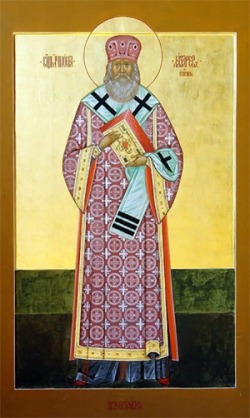
Bishop
Saint Iona (in the world Ivan Ivanovich Lazarev) was born in 1869 in the village of Luchino, Saint Petersburg province, in the family of a priest. In 1892, he graduated from the Novgorod Theological Seminary and was appointed as the supervisor of the Zvenigorod Theological School. On November 4, 1892, he was tonsured into monasticism with the name Iona, and on December 3, he was ordained as hierodeacon. On December 23, 1893, he was enrolled in the brotherhood of the Savvino-Storozhevsky Monastery, and on January 6, 1895, he was ordained as hieromonk. On December 30, 1899, at the request of Bishop Tikhon of Polotsk, he was enrolled in the brotherhood of the Polotsk Archierarchical House. On November 27, 1900, he was appointed as the abbot of the Nivelsky Spaso-Preobrazhensky Monastery. On September 2, 1902, he was transferred to the position of abbot of the Novgorod Skovorodsky Monastery and elevated to the rank of archimandrite. In 1907, he was appointed as the abbot of the Voskresensky Novoierusalimsky Monastery. In January 1918, he was sent to the disposal of Archbishop Tikhon of Voronezh. On January 29, 1926, he was ordained as Bishop of Nevel, but he could not assume his duties. On May 14, 1926, he was retired, living in the village of Batyushkovo, serving in the Nikolsky Church. During the persecutions of 1937, he was arrested on charges of counter-revolutionary agitation. On October 17, he was sentenced to death, executed on October 21, 1937, and buried in an unmarked grave. He was canonized among the ranks of the New Martyrs and Confessors of Russia in August 2000 for public veneration.
