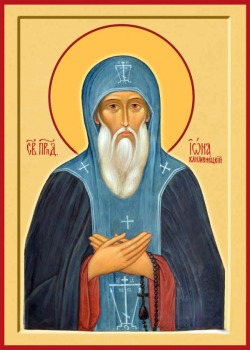
The heavenly goodness calls everyone to salvation, but not all in the same way. Some hear the calling from youth, others – in their mature years. This is the work of God's wisdom, which knows whom and how to call to Itself. Blessed is he who, having heard the voice of God, faithfully follows it. Such was the blessed Jonah of Kliment.
The Novgorod posadnik Ioann Klimentov left his son much wealth. His son Ioann engaged in trade, as did his father.
One day, returning from Povenets to Novgorod with a load of salt, Ioann encountered a terrible storm on Lake Onega. He began to pray to the Lord for deliverance from death, promising to accept monastic tonsure. His prayer was heard, and he was cast ashore on Kliment Island. Here he heard a voice commanding him to build a monastery in the name of the Life-Giving Trinity, and he found an icon of the Holy Trinity.
In 1490, he erected a cross at the place where he was cast ashore, and at the place of the apparition of the icon – a cross and a chapel. Returning to Novgorod, Ioann disposed of his possessions and, having accepted monastic tonsure with the name Jonah, went to the island.
On the island, he built two churches: in the name of the Holy Trinity and in the name of Saint Nicholas. Then the saint built cells and prepared everything necessary for the monastery of monks. The Trinity Nicholas-Kliment Monastery was founded around 1520.
Brothers from the Nyatin Monastery and monks from other places who desired solitude joined him. The Metropolitan of Moscow Varlaam blessed the altars of the monastery's churches with antimensia and wanted to appoint Saint Jonah as the abbot, but he humbly refused.
Saint Jonah peacefully reposed on June 6, 1534, and was buried near the church in the name of Saint Nicholas. Over the incorrupt relics of the saint, a chapel was later built, and during the reign of Elizabeth Petrovna – a stone church in the name of the righteous Zacharias and Elizabeth.
