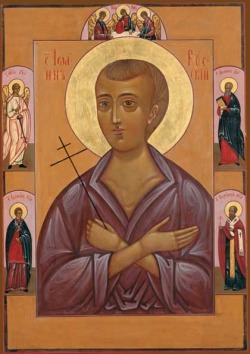
He was born in the late 17th century in Little Russia and was raised in piety. He served as a soldier in the army of Peter the Great and was captured during the Russo-Turkish War. Sold to a Turkish commander, he endured torture steadfastly and did not renounce Christianity, asserting: "I was born a Christian, and I will die a Christian." His kindness and diligence earned the respect of his master, who offered him freedom, but he preferred to remain in the stable for prayer.
Saint John served his master, helped the needy, and shared his food with them. Before his death, he called for a priest, who brought him the Holy Gifts, and he received communion, after which he departed to God on May 27, 1730. His body was buried according to Christian custom, and many Christians gathered for the burial.
Three and a half years later, the relics of the saint were found incorrupt and transferred to the church of Saint George the Great Martyr, where miracles began to occur. The saint became venerated not only by Orthodox Christians but also by Armenians and Turks. In 1881, part of the relics was transferred to the Russian monastery of Saint Panteleimon the Great Martyr.
In 1898, a new church in honor of Saint John of Russian was consecrated. In 1924, the relics were transferred to the island of Euboea, where they are located in the church of Saints Constantine and Helena, and in 1951 they were moved to a new church in honor of Saint John of Russian, where pilgrims flock, especially on the day of his commemoration, May 27.
