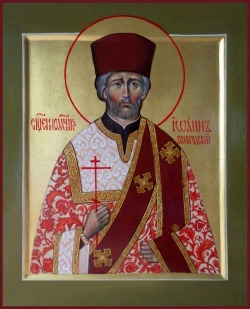
Deacon
Saint John the New Martyr was born on March 21, 1880, in the village of Vasilievskoye, in the Vologda province. He was the son of the chanter Alexander Preobrazhensky. In 1897, he graduated from the Vologda Theological School and was appointed as a chanter. In 1904, he was ordained a deacon, while in 1906 he began serving at the Vlasyevskaya Church.
In the 1920s, his church was closed, and he was assigned to serve at the Church of the Great Martyr Paraskeva Pyatnitsa. In 1929, he and his family were expelled from their home. Additionally, the authorities demanded that his wife would abandon him. From that time on, the family lived separately, supported by whatever means the saint was able to provide for them in secret.
In 1930, the authorities closed that church as well. The deacon was assigned to the Church of the Nativity of Theotokos. In May 1937, there was an announcement published in the local newspapers declaring the closure of the Bogorodskoye cemetery, which provoked the reaction of the parishioners. More than one hundred residents of Vologda signed a petition to the All-Russian Central Executive Committee, asking it not to proceed with this action and emphasizing the importance of the cemetery for the relatives of those buried there.
On June 26, 1937, during the celebration of an all-night vigil, the clergy were arrested, including Deacon John. He was interrogated and accused of counter-revolutionary propaganda.
On September 19, 1937, the NKVD troika sentenced him to ten years of imprisonment in a forced labor camp. The New Martyr died at the Kargopol camp on June 11, 1938. He was buried in an unmarked grave.
