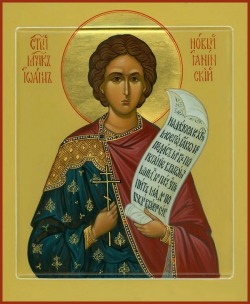
He was born in the city of Ioannina, Epirus. After the death of his parents, he became an orphan and moved to Constantinople, where he worked as a craftsman. For his virtuous life, he was nicknamed "the Epirus man." At that time, Constantinople was under Muslim rule, and many Christians turned away from their faith. Saint John openly confessed Christianity and rebuked the apostates, for which he became the target of hatred from his neighbors.
On Great Friday, he confessed to his spiritual father and expressed his desire to suffer for Christ. The protopsalti warned him, but John was determined. After a vision in a dream, where he did not burn in the fire, he again turned to his spiritual father for support.
In the market, he was accused of renouncing Christ and brought to trial. He steadfastly confessed his faith despite threats and beatings. He was imprisoned, where he continued to pray and did not renounce Christ. After brutal tortures, he was sentenced to be burned.
On the way to the place of execution, he continued to confess his faith despite humiliations. When he was brought to the pyre, he entered the flames himself but was pulled out by the executioners. Ultimately, he was sentenced to be beheaded. Saint John accepted martyrdom on April 18, 1526.
Despite the burning, the faithful found parts of his bones, which they kept with reverence, glorifying Christ. Amen.
