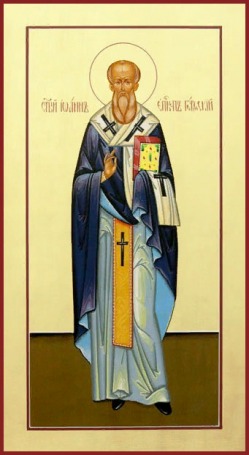
Bishop
Saint John, Bishop of Gothia, lived in the 8th century, born in Tauric Scythia (in Crimea) to pious parents Leo and Photina. From childhood, he was dedicated to the service of God and from youth he struggled in monasticism.
In 754, the Orthodox in Gothia elected John as bishop, but he did not immediately accept the office, instead visiting holy places. Upon returning, he went to Georgia, where he was consecrated.
In 780, during the reign of Empress Irene, he sent a scroll to Patriarch Paul of Constantinople outlining the faith regarding the veneration of icons. After Paul was removed, with Irene's permission, he participated in the Nicene Council, which restored the veneration of icons. Upon returning, he discovered that the Khazars had occupied Dori, the main city of his diocese. He convinced the ruler of Gothia to expel the Khazars, but the khan again seized the city, executed many, and imprisoned John. His faithful helped him escape to Amastris.
Four years later, hearing of the death of the Khazar ruler, the saint said: “In 40 days, I will go to judge him before Christ the Savior.” Indeed, after 40 days, on June 26, the saint passed away while addressing the people, in 790. He was honoredly escorted “with incense and candles to the very ship” by Bishop George of Amastris, and his body was delivered on July 29 to Gothia, to the monastery of Parphenit, located in Crimea at the foot of Mount Ayu-Dag, where he had previously lived and built a large church in the name of the holy apostles Peter and Paul.
The memory of Saint John is also celebrated on June 26/July 9.
