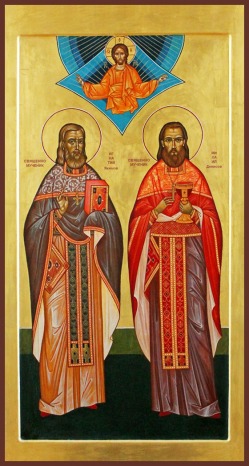
Presbyter
Saint Ignatius was born on 24 January 1872 in the village of Morozy, Vyatka. After graduating from the Nolinsk Theological School in 1889, he entered the Holy Monastery of Slobodskoy as a novice. He later studied church chanting at the Brotherhood of St Stephen of Perm. In 1891, he was appointed cantor at the Church of St Demetrius in the village of Osip. He was subsequently transferred to the Church of the Saviour in the village of Ryabki and, in 1896, to the Church of the Epiphany in the village of Yurlinskoye. On 6 June 1899, he was ordained a deacon and appointed a teacher of the Gospel at the Kukushki Literacy School.
On 2 November 1903, he was ordained a priest at the Church of the Nativity of Christ in the village of Tsuraki and appointed to serve at the Tsurakov Agricultural School. In 1913, he became the spiritual father of the local parishioners and in 1916 he was elevated to the rank of archimandrite.
Following the abdication of the Emperor, widespread unrest broke out across Russia. Father Ignatius spoke out against the looting of state forests and defended the oppressed peasants. However, an enraged crowd demanded the removal of the priest from the village.
On 17 September 1917, a peasant assembly was held, at which the decision to remove Father Ignatius from the village was formally adopted. He submitted a written appeal, arguing that he had been a victim of conspiracy.
Following the Bolsheviks' rise to the power, churches were subjected to violent attacks and looting. On 25 January 1918, Bishop Andronik of Perm sent a message to the parishes warning of the impending attacks. Father Ignatius read the bishop's message to the assembly and called upon his people to protect the church.
On 15 March 1918, the chairman of the Tsurakov Executive Committee filed a denunciation with the Investigative Commission, accusing Father Ignatius of counter-revolutionary activity. On 30 March, he was summoned for interrogation, during which he denied all the charges brought against him. He was released, but shortly afterwards, on 24 July 1918, he was arrested and executed.
