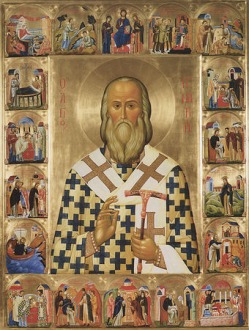
Bishop
Saint Ignatius (in the world Dmitry Alexandrovich Brianchaninov) was born on February 6, 1807, in Pokrovskoye, Vologda Governorate. From his early years he showed an interest in the monastic life, devoting himself to prayer and the reading of spiritual books.
At the age of 15, his father sent him to study at the Saint Petersburg Military Engineering School. The young man’s rare intellectual abilities and moral qualities attracted the attention of the school’s professors, teachers, and fellow students. Possessing remarkable poetic talent, he became known throughout Saint Petersburg and at the imperial court, and was a welcome guest in many aristocratic homes. A brilliant worldly career lay before him, but he submitted a petition for resignation, wishing to embrace monasticism. He was tonsured a monk with the name Ignatius.
In January 1832, he was appointed administrator of the Pelshem Lopotov Monastery, and in 1833 he became its hegumen. Later, on the recommendation of the Holy Synod, he was appointed abbot of the Sergius Hermitage. Having lived there for 24 years, he brought it into a flourishing condition.
On October 27, 1857, he was consecrated Bishop of the Caucasus and the Black Sea. The Caucasian War was underway, and the saint saw his most important task in apostolic service to his flock, in bringing peace to the fiery Caucasus, and in strengthening and expanding Orthodoxy there. In four years he founded a theological seminary and church schools, devoted all his strength to them, built new churches, put the diocesan administration in order, introduced solemn divine services, organized an excellent bishop’s choir, and built a bishop’s residence. In addition, he preached tirelessly.
A serious illness forced Bishop Ignatius in the summer of 1861 to submit a petition for retirement. He settled in the Nikolo-Babaevsky Monastery, where until the end of his life († 1867) he worked on his spiritual writings.
The name of Saint Ignatius Brianchaninov shines in the chronicles of the Church and of Russia as that of a creator of immortal spiritual works and a zealous guardian of Orthodox traditions.
