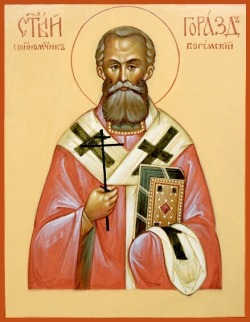
Bishop
He was born on May 26, 1879, in the family of an educated peasant, Jan Pavlik, and his wife Anna, in the village of Gruba Vrbka (South Moravia). In 1902, he graduated from the theological faculty and was ordained a priest on July 5. He served in a psychiatric hospital in Kroměříž, where he was respected.
During World War I, he condemned the aggression of Austria-Hungary and began publishing the magazine "The Right of the People," calling for reforms in the Roman Catholic Church. In 1920, he left the Roman Catholic Church and joined the Czechoslovak National Church, intending to defend the Orthodox direction.
From 1921, he held the position of church administrator in Moravia and Silesia, publishing the magazine "For the Truth," defending Orthodox principles. In 1921, he was ordained as the Bishop of Moravian-Silesian. In his activities, he encountered radicals who sought to destroy Roman Catholicism but did not support the strengthening of Orthodoxy.
From 1924, he began to build churches, actively engaging in missionary work and literary efforts. In 1938, after the Munich Agreement, he called the people to fulfill their Christian and patriotic duties.
During the occupation, he continued his work, calling for faith and hope. On June 25, 1942, he was arrested by the Gestapo and subjected to torture. On September 4, 1942, he was shot along with other clergymen. His martyr's death occurred for Christ.
Immediately after his death, veneration began, and in 1987 he was canonized as a saint. The vestment of the saint is kept in the Prague Cathedral.
