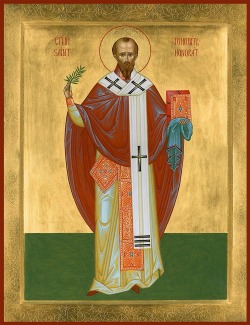
Bishop
Saint Honoratus was born in the Belgic Gaul in the mid-fourth century. He came from an aristocratic family. His father opposed his son’s desire to pursue a devout and ascetic life. Nevertheless, Honoratus never abandoned his calling. He devoted himself continually to prayer and became an example of piety to his elder brother, Venantius.
The two brothers lived humbly, welcoming people into their home and caring for travellers who passed through the area. At one point, they decided to become hermits. They found a spiritual guide, the devout Caprasius, and set out for the East in order to experience the monastic tradition. However, along the way, Venantius died and Honoratus was forced to return to southern Gaul, where he settled in a cave in the Esterel mountain range.
Around 400, he moved to the Lérins Islands, where he gathered a small community of disciples around him. The community continued to grow and flourish, transforming the area into one of the most important monastic centres in the West.
In 427, Honoratus was elected Bishop of Arles. In 429, sensing that his death was approaching, he proposed Hilary, a monk of the community, as his successor.
Honoratus was buried in the cemetery of Arles. In 1391, his relics were transferred to Lérins Abbey. During the French Revolution, the government confiscated most of his relics, while the remainder were distributed among various churches of the diocese in order to be protected.
At the end of the twentieth century, a part of the relics was returned to the abbey. The feast of Saint Honoratus is celebrated on 16/29 January.
