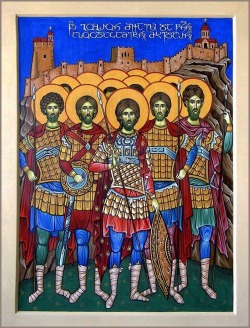
Martyr Gobron, in Holy Baptism Michael, and 133 soldiers, Georgian martyrs of the 10th century, came from a noble princely lineage. In 914, the Arab commander Abdul-Qasim captured Tbilisi and besieged the fortress of Kveli, defended by Saint Gobron and his soldiers. After a 28-day siege, the Arabs stormed the fortress and took its defenders captive.
The Georgian king Adarnase II ransomed many captives, but the Arabs refused to accept a ransom for Saint Gobron. The emir offered him to accept Islam, but he refused. Before the eyes of Saint Gobron, 133 of his soldiers were slaughtered for refusing to renounce their faith in Christ. Saint Gobron, dipping his finger in the blood of the martyrs, marked a cross on his forehead and, giving thanks to the Lord, accepted death by beheading on November 17, 914.
The body of Saint Gobron and the bodies of his 133 soldiers were buried in a common grave. 'A wondrous light illuminated the grave of the holy martyrs almost every night, and many sick people who came to the grave received healing.' The Georgian Church canonized martyr Gobron and his soldiers and established their feast day on the day of their martyrdom – November 17.
