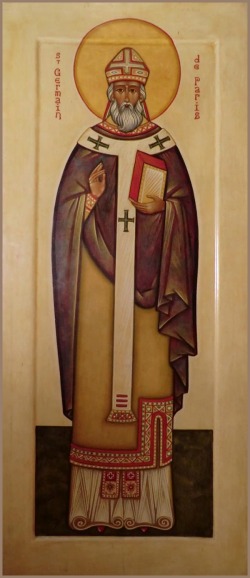
Bishop
He was born at the end of the 5th century in the city of Oten. After his studies, he withdrew to a relative who was a priest and led a pious life in prayer and psalmody for 15 years. His fame spread, and the Bishop of Oten ordained him as a priest and later appointed him as the abbot of the monastery of Saint Symphorian.
His strictness sometimes caused discontent with the bishop, and he was once imprisoned, but the doors of his cell opened by themselves, and he left only with permission. Around 555, he was summoned by King Hildebert to the Parisian see, but he did not change his strictness in life and attire, remaining a monk and ascetic.
The saint cared for the salvation of the people, and his sermons were confirmed by miracles. He healed the sick and the possessed, leaving them with him for prayer. His fame as a miracle worker spread everywhere, and objects blessed by him healed the afflicted. He distributed alms, spending the Church's resources, and sought help from the king, who was healed by him.
Germanus encouraged the veneration of local saints and cared for the beauty of the services, founding the monastery of the Holy Cross and Saint Vincent. He supported peace and unity in the Church of Gaul, and his voice was decisive at the Council of Tours (566). He convened two church councils in Paris (557; 573).
After the death of Hildebert (558), Paris became the capital of the united kingdom of Chlotar. Queen Radegund embraced monasticism, and the saint supported her decision. After a brief reign of Chlotar (561), the kingdom was divided among his sons. The King of Paris, Haribert, was impious and plundered churches, but soon died.
The saint tried to reconcile the wives of Sigibert and Hilperik, but after the murder of the sister of Brunhild, war broke out. The saint attempted to dissuade Sigibert from revenge, but he ignored the advice and was killed.
Germanus peacefully departed on May 28, 576, and was buried in the church of his monastery in Paris. During a great fire in 585, he appeared to free the prisoners who had taken refuge at his tomb.
