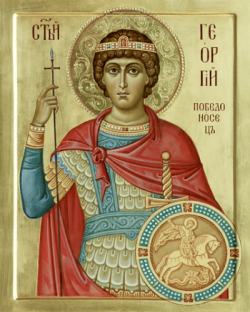
Saint George the Great Martyr was the son of a wealthy and pious family. His parents raised him in the Christian faith. He was born in the city of Beirut at the foot of the Lebanese mountains.
Upon entering military service, St. George distinguished himself among the other soldiers by his intellect, bravery, and nobility of character. After being elevated in the hierarchy, he became a favorite of the Emperor Diocletian, a fanatical believer of the Roman gods.
Hearing of the decision for the extermination of Christians, St. George felt compassion and repentance. He distributed his possessions to the poor, freed his slaves, and appeared before Diocletian, criticizing him for his cruelty. His speech was wise and full of arguments against the imperial command.
After unsuccessful attempts to persuade him to renounce Christ, the emperor ordered St. George to be subjected to tortures. He was imprisoned and tortured. However, he bravely endured all the torments, praying to God and glorifying His name.
Eventually, the emperor ordered his head to be cut off. Thus, St. George departed to Christ in 303 in Nicomedia.
For his courage and spiritual victory over the torturers, as well as for his miraculous help to people in need, St. George is also called the Victorious. His relics were laid in the Palestinian city of Lydda, while his head was kept in Rome in a temple dedicated to him.
