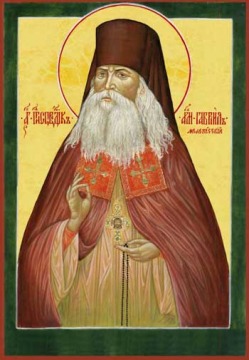
Archimandrite
The Holy New Martyr Gabriel of Melekess was born on 23 May 1888 in the village of Samodurovka, in the Penza province, to the peasant Ivan Igoshin. At his baptism, he received the name John. From an early age, he became used to the hardships of rural life, helping his father with agricultural work. After completing his elementary education, he entered the Zhadovskaya Pustyn Monastery on 12 November 1903.
Having completed his military training, he was called to active service in 1914, where he served as a chanter. At the end of 1917, he was discharged and returned to his family home. In 1921, he was ordained a deacon, while in 1922 he was ordained to the priesthood. He served at the Church of the Protection of the Most Holy Theotokos in the Martha and Mary Convent.
In 1929, he was tonsured as a monk and received the name Gabriel. The following year, he was elevated to the rank of hegumen. He was first arrested on 14 April 1931 and sentenced to three years' imprisonment. After his release, he continued serving the Church until he was arrested again in 1934. On 3 October 1934, he was released.
He went on to serve in various churches, consistently earning the respect and love of his parishioners. In 1936, he was arrested during the Divine Liturgy on charges of counter-revolutionary activity. On 20 January 1937, he was sentenced to five years of forced labor. Although he endured many hardships, he never ceased serving the Church or offering spiritual care to those in need.
He was released in July 1942 and returned to Melekess, where he resumed his pastoral ministry, strengthening the faith of his flock. In 1949, he was arrested once more and sentenced to ten years of imprisonment. Because of serious illness, he was released in 1954 and returned to Melekess, where he continued to minister faithfully and help those around him.
Saint Gabriel reposed on 18 October 1959 and was buried in the municipal cemetery. On 5 (18) October 2000, his holy relics were solemnly uncovered and translated to the Church of Saint Nicholas in the city of Dimitrovgrad, where they are preserved for veneration to this day.
