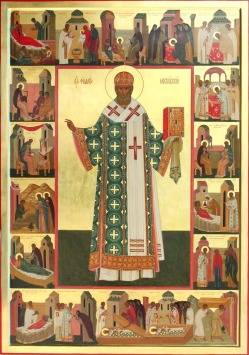
Metropolitan Bishop
Saint Philaret was born on December 26, 1782, in Kolomna, into a family of clergy. In 1802, he was appointed to a senior position at the hospital, an experience that helped him develop deep compassion for those around him. In 1808, he embraced the monastic life, receiving the name Philaret. He was also ordained a hierodeacon.
He served at the Holy Trinity Lavra and was later called to Saint Petersburg to teach at the newly established theological academy. In 1810, he began lecturing in Russian, which attracted the attention of Metropolitan Platon. In 1812, he was appointed lecturer at the academy and professor of theological sciences.
In 1817, he was consecrated Bishop of Reval, while in 1819 he was transferred to the See of Tver. There he actively participated in the celebration of the Divine Liturgy and preached the Gospel, traveling throughout the regions of his diocese. In 1820, he was transferred to Yaroslavl, while in 1821 he was appointed Metropolitan of Moscow.
In 1836, he played an active role in important reforms, and drafted a manifesto for the Tsar.
Throughout his life, he remained steadfast in the principles of Christian morality and justice, diligently caring for the spiritual welfare of his flock. He also worked toward restoring the unity of the Church and sought to heal the divisions that had arisen within it.
He reposed in the Lord on November 19, 1867. His holy relics are preserved in the Cathedral of the Saviour in Moscow.
