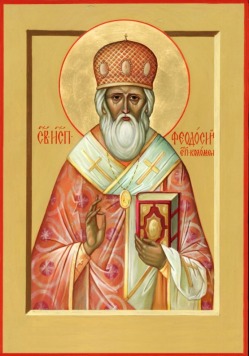
Bishop
He was born on July 30, 1860, in the village of Ruda, Vasylkiv district, Kyiv province, in the family of a priest, Feodor Ganitsky. He was baptized with the name Ioann. After graduating from the Kyiv Theological Seminary, he taught the Law of God at the Ak-Shenkhskoe folk school from February 20, 1882, to August 25, 1890. He then worked as an accountant in the Treasury until April 17, 1899, when he was tonsured into monasticism with the name Theodosiy and ordained as a hierodeacon and hieromonk. He was appointed the rector of the church at the diocesan candle factory.
From May 5, 1900, he served as the economist of the Taurida archbishop's house, and from August 15 of the same year, he was the rector of the Bakhchisarai Assumption Skete. On December 17, 1900, he was elevated to the rank of igumen and appointed the rector of the Balaklava Georgievsky Monastery. He was awarded a pectoral cross for his diligent service.
On August 11, 1903, he was enrolled in the brotherhood of the Moscow Pokrov Missionary Monastery. In 1904, during the Russo-Japanese War, he was appointed the rector of the field church of the Holy Eugenia Red Cross detachment. For his bravery, he was awarded numerous honors. He returned to the Moscow Pokrov Monastery on November 10, 1905.
From July 12, 1906, he served in the Moscow Chudov Monastery, and from May 25 to July 25, 1907, he temporarily performed the duties of the abbot of the monastery. In early March 1909, he was appointed the abbot of the Moscow Zlatooust Monastery and on March 25 was elevated to the rank of archimandrite. In 1912, he was included in the construction committee for the erection of a church in memory of the abolition of serfdom.
With the onset of World War I, on August 13, 1914, he was appointed chairman of the Military Charitable Monastic Committee of the Moscow Diocese. On January 2, 1916, he was awarded a gold pectoral cross with decorations for his assistance to sick and wounded soldiers.
On May 18, 1920, he was consecrated as Bishop of Kolomna and Bronnitsy, vicar of the Moscow Diocese. Upon arriving in Kolomna, he was placed under surveillance by the Cheka. He participated in processions and liturgies, preaching about eternity and humility. On June 16, 1921, he conducted a procession, for which he was summoned for questioning by the Cheka.
On June 27, 1921, Cheka officers seized leaflets mentioning the deceased Grand Duke Nikolai Alexandrovich, which became the basis for questioning. As a result, he was arrested on July 13, 1921, and accused of counter-revolutionary agitation, but he did not admit his guilt. On October 4, 1921, the case was closed, and he returned to his ministry in Kolomna.
In the spring of 1922, having not supported Patriarch Tikhon's call to surrender church valuables, he was searched and arrested in December 1922 on charges of resisting the seizure of church valuables. In 1923, the investigation was completed, and he was released in 1924.
In 1925, he restored monastic life in the Kolomna monasteries. On September 25, 1929, he was retired, and on November 25, he was arrested again. He was accused of organizing counter-revolutionary activities and sentenced to five years of exile in the Northern Territory. He was released on May 28, 1933, returned to Kolomna, and then settled in the village of Sushkovo, where he died on May 3, 1937.
Many clergy and believers gathered for his burial. He was buried behind the altar of the Kazan Church, which was closed after the arrest of the last rector. The relics of the saint were discovered on May 16, 2006, and transferred to the Sergiev Church of the Bogolyubensky Staro-Golutvin Monastery in Kolomna.
