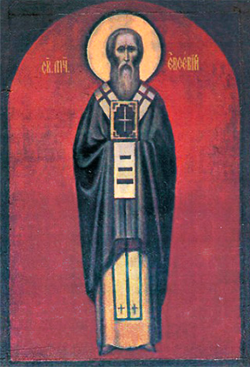
Saint Eusebius was the Bishop of Samosata. He was a righteous and devout man, distinguished by his great zeal for the faith and his deep trust in the love of God.
He lived during the period of the controversy surrounding the heresy of Arius. After the death of Emperor Constantine, his son Constantius, a supporter of Arianism, started severe persecutions against Christians. During this time, the saint endured many sufferings for the sake of his faith.
At the Synod of Antioch, Saint Eusebius proposed Bishop Meletius for the patriarchal throne. After his elevation, Meletius openly confessed the Orthodox faith and was consequently exiled by the Arians. Despite the threats he faced, Saint Eusebius refused to condemn him. His courage astonished the emperor. He continued to defend Orthodoxy in every possible way, appointing bishops who firmly rejected all heretical teachings.
During the reign of Emperor Julian, the persecutions against Christians were intensified. Saint Eusebius persisted in his missionary work, steadfastly supporting the Orthodox faith. After the emperor’s death, his successor recalled Saint Meletius and the other exiled bishops.
In the persecutions that followed in later years, Saint Eusebius himself was exiled, a departure that caused great sorrow among the faithful. However, the next emperor allowed all the exiles to return, thus restoring the saint to his duty. Continuing his pastoral care for the Church, Saint Eusebius appointed worthy bishops.
Ultimately, he was mortally wounded by an Arian woman during one of his journeys and soon passed away. His body was buried with great honor, while he was succeeded by the blessed Antiochus.
