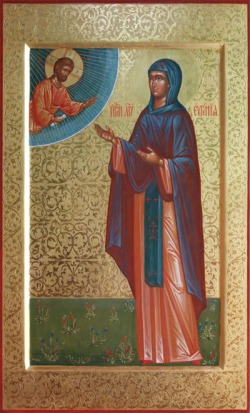
Nun
Saint Eugenia was born in 1892 in the village of Nikitkino, Yegoryevsky district of Ryazan province, in the family of a small grocery store owner, Afanasy Lysov, and was baptized with the name Evdokia. She received her education at a church-parish school. In 1916, her parents passed away, and both of her sisters had married and lived separately by that time. Raised in piety, Evdokia decided to dedicate her life to serving the Lord. She sold the household livestock and gave the house inherited from her parents to her sister, receiving in return a small house where she arranged her cell. During the persecutions by the godless authorities, while being spiritually guided by one of the monks at the Bogoslovsky Monastery in the Ryazan region, she was tonsured into monasticism in 1926, taking the name Eugenia. When the monastery was closed, she returned to her native village and began to serve at the Pokrovskaya Church.
In 1931, the sisters of the Kolychovsky Kazan Monastery were arrested and imprisoned in Yegoryevsk. Immediately after their arrest, believers and nuns from closed monasteries, many of whom had settled in Yegoryevsk, organized assistance with food and clothing. A dozen nuns kept vigil near the prison around the clock, so that when the arrested were led from the prison to the station, they could say goodbye to the confessors. Eventually, it became known that the sisters of the Kazan monastery would be transported on June 12. On that day, starting from 10 a.m., nuns, clergy, and believers began to gather at the prison gates. About a hundred people gathered in total. Later, one of the witnesses testified that the priests and nuns 'conducted agitation among the townspeople about the fact that the Soviet government was pursuing a policy of the final destruction of religion. They are judging and exiling innocent people. Three days before the transportation... the nuns organized a night vigil at the prison, and townspeople gathered around them... among whom the nuns, with tears, agitated — we must endure, they will take them away, we will soon be taken.'
Before the nuns were led out of the prison, when there were already quite a few believers in the square, police officers appeared and began to arrest those gathered. Seeing this, some began to flee. In the following days, arrests were also carried out among nuns and believers in Yegoryevsk and nearby villages.
Nun Eugenia was arrested on June 25, 1931, and sent to prison in Yegoryevsk. Answering the investigator's questions, she said: 'After my parents died... I began to lead a monastic life, I went and still go to church, I serve together with the priest... and I hold on to this life...' A total of eighteen people were arrested in this case. On July 16, 1931, the troika of the OGPU of the Moscow region sentenced nun Eugenia to three years of exile in Kazakhstan, with the term of exile counted from June 12, when the nuns were arrested in the square.
In 1934, after completing her term of exile, nun Eugenia returned to her homeland and settled in Yegoryevsk, where other nuns and clergy returned from exile. Eugenia began to assist at the church of Saint Blessed Prince Alexander Nevsky. Nuns, novices, and pious women began to perform the established services in homes; small monastic communities began to form in cities and villages. In the house in Yegoryevsk, together with nun Eugenia lived schemamonk Agnia from the Kolychovsky Monastery and a pious woman who later took monasticism with the name Seraphima, while a teacher named Olga, who very much wanted to take monasticism but was not blessed to do so due to the ongoing persecutions, came to help them. Many were afraid to pray, and common prayer in the house, even if it was just reading the Psalter or the midnight office, the service of Vespers, Matins, or the Hours was equated with a violation of the law on the separation of Church from state and was fraught with imprisonment. Many were afraid to gather in homes for prayer, but Eugenia, countering these fears, said: 'I was in exile, I am not afraid.' By the time of the new arrests, the schemamonk had passed away, and all others, including nun Eugenia, were arrested in April 1935.
— Tell me, where and when did you participate in secret prayers in the apartments of believers? — asked her investigator.
— I have never attended secret prayers; perhaps they were somewhere in Yegoryevsk, but I am unaware of them.
— Do you admit your guilt in the charges against you?
— I do not admit my guilt in the charges against me.
On June 14, 1935, the Special Meeting of the NKVD sentenced her to five years of imprisonment in a labor camp, and she was sent to a camp near Tashkent. From the camp, she wrote to her relatives asking them to send her some crackers; after a while, having received them, she wrote back that they should not send anything more, as their camp was being transferred to another place and she would inform them of the new address upon arrival. However, the conditions of this transfer turned out to be so harsh that she could not endure them. Nun Eugenia (Lysova) passed away on November 17, 1935, in custody and was buried in an unmarked grave.
