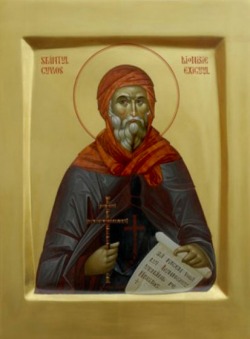
St. Dionysius the Little, the founder of the Christian calendar, was of Scythian origin but spent most of his life in monasticism in Rome. He arrived there at the end of the 5th century and remained until his death. He is known as a strict guardian of monastic virtues, especially humility. Possessing a profound knowledge of the Greek language, he rendered significant services to ecclesiastical law and Christian chronology.
He is credited with the following works:
- A collection of the acts of councils in two editions, consisting of a translation of 50 apostolic rules and canons from various councils.
- A collection of decretals, the oldest compilation containing letters from the Roman popes.
- The Paschal, a continuation of the 95-year Paschal of Cyril of Alexandria, in which he introduced the dating from the Incarnation of the Lord.
He determined the Nativity of Christ on December 25 of the 1st year of his era, and the day of the “Incarnation” on March 25. His Paschal cycle was accepted in Rome and then in the rest of Italy, and by the end of the 6th century in Gaul and the British Church. During the time of Charlemagne, his dating system came into official use in the Church.
