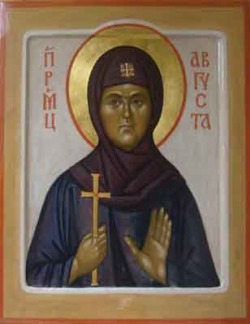
Schemanun
The verdict of the special troika of the NKVD of the Tula region was announced on the eve of the Christmas holiday. In the frosty January days of 1938, the schemamonk Augusta (Zashchuk), the abbot of Optina Monastery Isaac (Bobrikov), hierodeacon Vadim (Antonov), novices Grigory Larin, Daniil Pyatibrat, and about twenty nuns, priests, and laypeople awaited execution.
Schemamonk Augusta immersed herself in prayer. She was about seventy years old, and in this plump woman, with bright, clear eyes on a kind, tired face, it was hard to recognize the thin, shy girl — Lydia Vasilyevna Kaznakova. Everyone had long gotten used to her new name and simply addressed her as Mother Augusta.
The future holy martyr was born on June 2, 1871, in St. Petersburg and was baptized with her mother’s name — Lydia. Lidochka was a frail girl, so she constantly lived and was raised in the estate. When she turned six, her father passed away. After the death of Vasily Genadievich Kaznakov, the remaining inheritance was divided among the brothers, the widow, and little Lydia.
Lydia Kaznakova stood out with her great abilities, studied well and eagerly, although she did not have good health. After finishing the institute, Lydia moved with her mother to Tver province, to her grandfather, where she stayed for two years. Upon returning to the capital, she began living in furnished rooms. Here, a young, brilliantly educated officer, Vsevolod Zashchuk, also settled. Two years after their acquaintance, they got married.
Only two years of married life were joyful for Lydia. Lydia treated her husband with remarkable modesty and trust, while receiving only rudeness in return. The marriage presented Lydia with great lessons in patience and humility, without which it is impossible to endure monastic life. The spouses lived together for ten and a half years and parted ways.
In 1911, she managed to go to Monte Carlo, where she modestly, without even keeping a servant, remained until October 10. The revolutionary upheavals in the capital found L.V. Kaznakova working at the City Duma, where she issued industrial certificates. Her soul aspired to God, to Optina Monastery: the thought of becoming a nun and leaving worldly life was born.
In Optina Monastery, breathing in the departing grace, she not only heard memories of the great elders but also encountered some of them. In Optina Monastery, Lydia Vasilyevna worked for about a year and a half as an accountant for the distribution of bread in the agricultural cooperative, and from December 1919, she began working in the Optina museum.
On December 16, 1937, Mother Augusta was arrested along with twenty monks, nuns, laypeople, and priests in the city of Belev. On January 8, 1938, the holy martyr Augusta (Zashchuk), along with other priests and nuns, was taken to the 162nd km of the Simferopol highway near Tula, where gunshots rang out into eternity.
