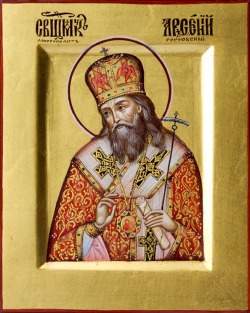
Metropolitan Bishop
Archpriest Arsenius, Metropolitan of Rostov, was born in 1697 in Vladimir-Volynsky to a family of Orthodox priests. After receiving an education at the Kyiv Theological Academy, he became an hieromonk in 1733 and undertook a journey to Ustyug, Kholmogory, and the Solovetsky Monastery, where he polemicized with the Old Believers.
From 1734 to 1737, he participated in the Kamchatka Expedition. In 1741, he was consecrated as the Metropolitan of Tobolsk and all Siberia, where he defended the rights of newly baptized indigenous people and the clergy from the oppression of secular authorities. In 1742, he was transferred to the see in Rostov and became a member of the Synod.
Archbishop Arsenius opposed the secular authorities, insisting on the removal of secular officials from the Synod and the restoration of the Patriarchate. His note “On Church Order” became the first protest against the synodal system.
Relations with the authorities worsened when orders aimed at limiting monasteries in managing their properties caused discontent among the higher clergy. On February 9, 1763, the archbishop performed the “Rite of Excommunication” against those who offended the Church and monasteries.
In March 1763, he was condemned as an “offender” of Empress Catherine II and demoted to the rank of a simple monk, then imprisoned in the Nikolai-Korelsky Monastery. Even in exile, he continued to denounce the actions of the authorities and expressed doubts about Catherine II's rights to the throne.
At the end of 1767, he was stripped of his monastic status and sentenced to “eternal confinement.” Under the name “Andrei Vralya,” he was held in the Revel prison, where he died on February 28, 1772. For his humble endurance of sufferings and his martyr's death, he is venerated among the Russian people.
He was canonized by the Russian Orthodox Church for public veneration at the Jubilee Archpastoral Council in August 2000.
